
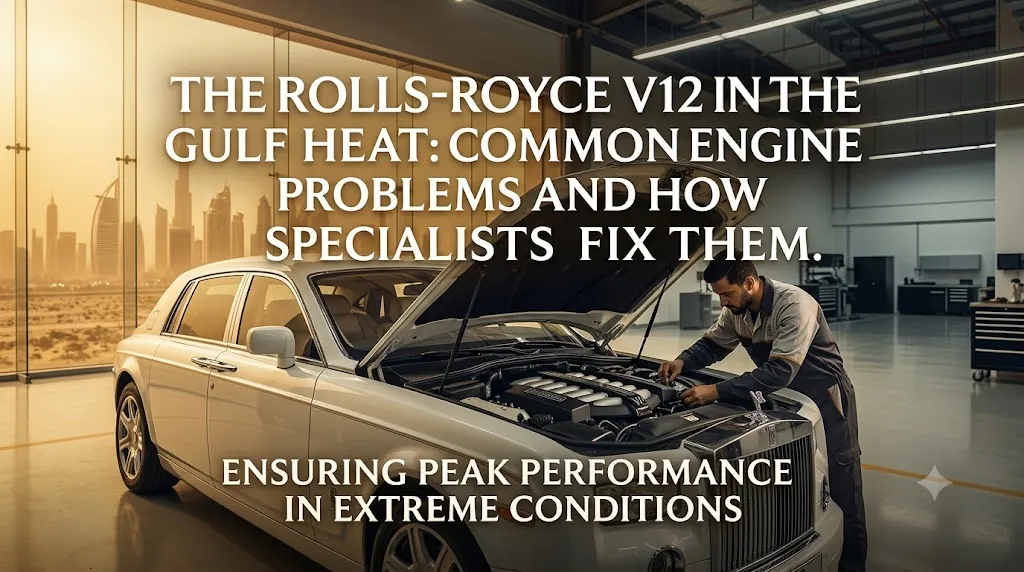
The 6.75-litre twin-turbocharged V12 in the current Phantom and Cullinan, and the 6.6-litre unit in the Ghost, Wraith, and Dawn, are engineering masterpieces — near-silent at idle, effortlessly powerful, and built to cover enormous distances. Yet even a masterpiece has service requirements, and the operating conditions in Dubai are about as far from the engine’s German test benches as it is possible to get.
Ambient temperatures that exceed 48°C, stop-start traffic that keeps airflow through the radiators to a minimum, fine airborne dust, and short journeys in which the oil never fully reaches temperature: this combination produces a distinct pattern of engine issues that UAE-based Rolls-Royce technicians see over and over again. This article walks through the most common ones, what causes them, and what a competent repair actually involves.
1. Cooling System Stress and Coolant Leaks
The V12’s cooling system is large and complex — multiple radiators, electric auxiliary pumps, an electronically controlled thermostat, and metres of hose. In Gulf conditions, the system runs near the top of its design envelope for months at a time.
The weak points are predictable. Plastic hose connectors and expansion tanks become brittle after years of thermal cycling and begin to weep coolant. The electric auxiliary water pumps, which continue circulating coolant after shutdown to prevent heat soak damage to the turbochargers, wear out faster because they run longer and harder here. And the coolant itself degrades more quickly, losing its corrosion inhibitors and allowing internal deposits to form.
Symptoms: a coolant level warning, a faint sweet smell after parking, visible crusty residue around hose joints, or in advanced cases a rising temperature gauge in traffic.
The correct repair is never just topping up the coolant. A specialist will pressure-test the entire system, inspect every plastic junction under load, verify auxiliary pump operation electronically, and replace degraded components with genuine parts. On higher-mileage cars, proactive replacement of known-vulnerable plastic fittings during other work is money well spent — a coolant loss event on a V12 that goes unnoticed can mean a warped cylinder head and a five-figure repair.
2. Oil Leaks: Valve Cover Gaskets and the Lower Engine
Heat is the enemy of gaskets. The rubber and composite seals around the valve covers, the oil filter housing, and the upper timing case harden and shrink in sustained high temperatures. The first sign is usually a light oil film on the engine, then the distinctive smell of oil dripping onto hot exhaust components, and eventually spots on the garage floor.
On the V12, valve cover gasket replacement is a labour-intensive job — much of the intake plumbing and ancillary equipment must come off to reach the covers — which is exactly why it should be done properly the first time, with genuine gaskets, correctly torqued fasteners, and new seals on everything disturbed during disassembly. A workshop that quotes suspiciously cheap for this job is almost certainly cutting corners on parts or reusing seals that should be renewed.
3. Turbocharger and Charge-Air Issues
Both turbochargers live in an extremely hot environment made hotter by Gulf summers. The most common problems are not catastrophic turbo failures but the supporting cast: perished charge-air hoses that leak boost, sticking wastegate actuators, and oil supply lines that begin to coke internally when the car is repeatedly shut down hot without a cool-down period.
Symptoms: a subtle loss of the effortless mid-range surge, a whistle or hiss under acceleration, or fault codes for boost pressure deviation.
Diagnosis requires a smoke test of the charge-air system and live-data analysis of commanded versus actual boost. The repair may be as simple as a hose and clamps — or, if oil starvation has damaged a turbo bearing, a turbocharger overhaul. Catching it at the hose stage is the difference between hundreds and many thousands of dirhams.
4. Carbon Build-Up on Direct-Injection Engines
Like most modern direct-injection engines, the Rolls-Royce V12 is prone to carbon accumulation on the intake valves, because fuel no longer washes over them. Dubai driving patterns — short air-conditioned hops, long idling, low average speeds — accelerate the build-up.
Symptoms: slightly lumpy cold idle, gradual loss of throttle sharpness, occasional cold-start misfire codes.
The proven fix is walnut-shell blasting of the intake ports, a job that requires removing the intake manifolds and using purpose-built equipment. It is meticulous work on a V12, but it restores the engine to factory smoothness. Fuel additives alone cannot remove hardened deposits; any workshop claiming otherwise is selling optimism.
5. Ignition System Wear
Twelve cylinders means twelve ignition coils and twelve spark plugs, and heat shortens the life of all of them. A single failing coil on a V12 can be surprisingly subtle — the engine is so smooth that a dead cylinder may only reveal itself as a faint vibration at idle or a check-engine light with a misfire code.
The right approach is diagnostic, not guesswork: identify the misfiring cylinder electronically, swap components to confirm, and then make an informed decision about replacing coils individually or as a set depending on age and mileage. On cars past 60,000 km in this climate, replacing all plugs and assessing all coils together is usually the economical path.
6. Engine Mounts and the “Lost Smoothness” Complaint
One of the most frequent complaints specialists hear is not a fault code at all: “the car doesn’t feel as smooth as it used to.” Very often the culprit is the hydraulic engine mounts, which are fluid-filled to isolate the V12’s already-minimal vibration from the cabin. Heat degrades the fluid and rubber; the mounts collapse gradually, and vibration creeps into the structure so slowly the owner adapts without noticing — until they drive a healthy example.
Mount replacement with genuine hydraulic units restores the isolation completely. It is one of the most satisfying repairs a Rolls-Royce can receive, because the transformation is immediate.
Why Specialist Diagnosis Matters More Than Anywhere Else
Everything above shares a theme: on a Rolls-Royce, the symptoms are quiet and the stakes are high. The engineering that makes the car serene also masks developing faults until they are advanced. This is why generic garages, however well-intentioned, so often misdiagnose these engines — they lack both the factory-level diagnostic access and the pattern recognition that comes from working on these specific cars daily.
Owners searching for trustworthy rolls royce repair dubai should look for a workshop that can demonstrate three things: manufacturer-grade diagnostic equipment with full module access, technicians with verifiable Rolls-Royce or BMW Group experience (the engines share deep engineering DNA), and a willingness to explain findings with data — fault codes, live readings, pressure test results — rather than vague assertions.
Practical Habits That Protect the V12 in Dubai
- Respect the cool-down. After a hard run, let the engine idle for 30–60 seconds before shutdown so the auxiliary pumps and oil flow can protect the turbos.
- Shorten oil intervals. The official schedule assumes moderate climates. In the Gulf, changing the oil every 10,000 km — or annually, whichever comes first — with the correct specification oil is cheap insurance.
- Use quality fuel. Consistent premium fuel from major stations reduces injector and carbon issues.
- Watch the coolant. Glance at the level monthly in summer. A slow drop is a message.
- Annual pre-summer inspection. Have the cooling system, belts, hoses, and battery checked each spring, before the heat arrives.
The V12 was built to last decades. In Dubai, whether it does depends less on the engine and more on the discipline of its maintenance — and the expertise of the hands it is entrusted to.