Audi Wheel Alignment & Balancing

Audi Wheel Alignment Dubai — Precision Four-Wheel Geometry & Balancing

Looking for expert Audi wheel alignment Dubai drivers can actually trust? Audi Repair Dubai is an independent Audi-only specialist workshop setting live four-wheel geometry and road-force balancing to factory tolerances on every model from the A1 to the R8. Dealer-level precision, honest pricing, and free pickup and drop-off anywhere in Dubai.

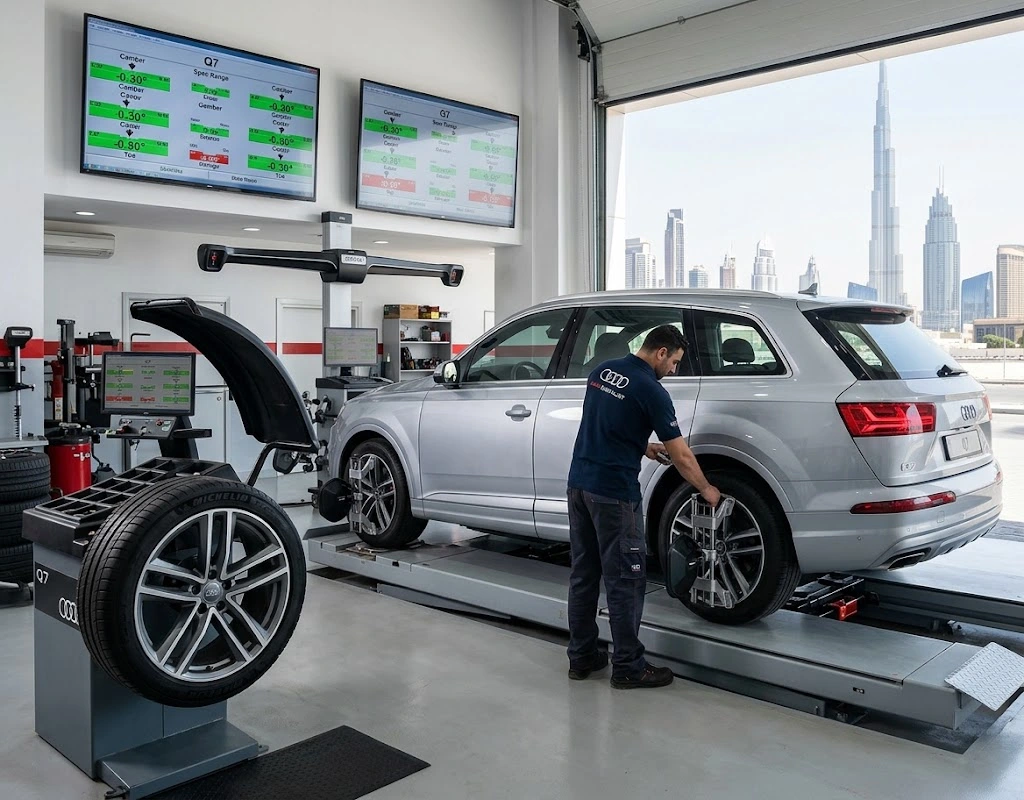
Audi wheel alignment Dubai specialist setting four-wheel geometry on an Audi at Audi Repair Dubai
Why Specialist Care Matters

What Audi Wheel Alignment And Balancing Actually Involves

Wheel alignment and wheel balancing are two different jobs that get bundled together because they solve two halves of the same problem: making your Audi track straight, ride smooth, and wear its tyres evenly. Get either one wrong on a modern Audi and you will feel it within a week of Dubai driving.

Alignment is the geometry of the suspension. It describes the exact angles at which each wheel sits relative to the road surface, relative to the car's centreline, and relative to the other three wheels. Audi sets those angles at the factory in fractions of a degree, and the tolerance windows are tight — often plus or minus six to twelve minutes of arc on a toe setting. That is a few millimetres measured at the rim edge. It is far too fine to judge by eye, by tape measure, or by the old string-and-straightedge method that still gets used in cheap tyre shops around the city.

Balancing is about mass distribution. A wheel and tyre assembly is never perfectly uniform. The tyre has a heavier point where the joint in the carcass sits. The rim has casting variation. The valve, the TPMS sensor and the wheel weights all add mass at specific points. Spin that assembly at 120 km/h on the Sheikh Zayed Road and even a 15-gram imbalance generates a rhythmic force that reaches the steering wheel, the seat rails and the mirrors. On a 21-inch RS wheel with a 30-series tyre, the sidewall has almost no compliance to absorb it, so everything transmits straight into the cabin.

The Four Angles Your Audi Is Measured On

A proper four-wheel alignment on an Audi looks at more angles than most drivers realise. Each one does a different job, and each one fails in a different way.

  • Toe — whether the wheels point slightly inwards or outwards when viewed from above. This is the angle that destroys tyres fastest. A toe error of half a degree can scrub a set of Michelin Pilot Sports down to the wear bars in under 12,000 kilometres. Audi specifies individual toe per wheel plus a total toe figure, and on Quattro cars the rear toe matters just as much as the front.
  • Camber — the inward or outward lean of the wheel viewed from the front. Audi runs negative camber front and rear for cornering stability, and the S and RS cars run noticeably more of it. Excessive or uneven camber shows up as inner-shoulder tyre wear and a car that pulls towards the side with the more positive reading.
  • Caster — the forward or rearward tilt of the steering axis. Caster gives you straight-line stability and self-centring steering. It is not adjustable on many Audi platforms, which makes it a superb diagnostic angle: if caster is out on one side, something structural has moved, usually a bent lower control arm or a subframe that has shifted after a heavy kerb strike.
  • Thrust angle — the direction the rear axle is actually pushing the car. If the rear axle is not square to the centreline, the car crabs down the road and the steering wheel sits off-centre even when the front toe is perfect. This is the single most common reason a car "still pulls" after a cheap front-only alignment.

Why Dubai Roads Are Unusually Hard On Audi Geometry

Dubai has excellent asphalt by global standards, which fools people into thinking alignment is a non-issue here. In practice, this city knocks Audi suspension out of specification faster than most European cities, for a handful of very specific reasons.

The first is the speed-bump density in residential and community areas. Jumeirah, Umm Suqeim, Al Barsha South, Mirdif, The Springs, Arabian Ranches and Al Warqa are laced with aggressive, sharply crested humps. A lowered S4 or an A5 on 20-inch wheels taken over one of those at 30 km/h rather than 15 km/h loads the front control arm bushings hard enough to shift toe measurably over time.

The second is kerbing. Multi-storey parking at Dubai Mall, Mall of the Emirates, City Walk and the DIFC towers has tight helical ramps with raised concrete edges at exactly rim height for a car with 255-section rubber. Most Audi owners in Dubai have clipped one at some point. A single firm kerb strike at 10 km/h is enough to knock a front wheel out of camber specification and, in some cases, to put a small buckle in the rim that no amount of balancing will fully cure.

The third is heat and expansion-joint impact. Summer tarmac temperatures on the E11 and E311 regularly exceed 60°C at the surface. Hot rubber is softer rubber, and softer rubber transmits less shock but also wears faster when the geometry is wrong. Add the repeated thump of concrete expansion joints on the flyovers at Al Garhoud, Al Safa and Business Bay, and suspension bushings age faster than their mileage would suggest.

The fourth is sand. Fine dust works its way into wheel weight adhesive, into the bead seat between tyre and rim, and into the threads of the adjustment eccentrics on the rear axle. That last one matters a lot. Rear camber and toe bolts that have been baked and dusted for four years can seize solid, which is why an Audi specialist will always plan for penetrating fluid and controlled heat rather than snapping a bolt in an aluminium subframe.

Alignment Is Not A One-Off Job On A Modern Audi

Older cars were simple: set the toe, drive away. A current Audi carries a steering angle sensor in the steering column, an ESC yaw-rate sensor under the centre console, and on most 2017-onward cars a forward-facing camera behind the windscreen plus radar in the front bumper. All of those systems reference "straight ahead" against the mechanical geometry of the car.

Change the geometry and you have to tell the electronics. If you do not, you can end up with a perfectly aligned Audi that still drifts within its lane under Adaptive Cruise Assist, or that throws an ESC light on the first roundabout because the steering angle sensor and the yaw sensor disagree. This is where a general tyre shop and an Audi specialist part company — and it is the main reason customers come to us after paying for an alignment somewhere else that did not solve the problem.

Warning Signs

Signs Your Audi Needs Alignment Or Balancing

Alignment and balancing faults produce different symptoms, and telling them apart before you book saves time and money. Here is how to read what your Audi is telling you.

Steering Wheel Sits Off-Centre

You are driving dead straight down Al Khail Road but the Audi rings badge is tilted 5 to 10 degrees. This is the classic alignment giveaway. It usually means front toe has been split unevenly between left and right, or that the rear thrust angle is off and the front is compensating.

The Car Pulls To One Side

Release the wheel briefly on a flat, straight stretch and the car wanders left or right. Bear in mind Dubai roads are cambered for drainage, so a very slight drift is normal. A pull you have to actively correct is not.

Vibration At 90 To 120 km/h

A rhythmic shimmy that appears in a specific speed band and fades above and below it is almost always a balance problem. If it is felt through the steering wheel, suspect a front wheel. If it is felt through the seat and floor, suspect a rear wheel.

Uneven Or Feathered Tyre Wear

Run your palm across the tread. If it feels smooth one way and sharp the other, that is feathering from a toe error. Wear concentrated on the inner shoulder points to camber. Wear on both outer shoulders usually means under-inflation rather than geometry.

Squealing Tyres On Normal Turns

If your Q5 chirps its front tyres pulling out of a car park at walking pace, the front wheels are fighting each other. Excessive toe-in or toe-out makes the tyres scrub sideways at low speed and it is audible on smooth polished concrete.

Lane Assist Behaving Oddly

Lane Departure Warning nudging you for no reason, or Adaptive Cruise Assist hugging one side of the lane, often traces back to geometry that was changed without a steering angle sensor reset and camera recalibration afterwards.

Steering Feels Loose Or Vague

A dead spot around the straight-ahead position can be caster loss on one side, or worn track rod ends and control arm bushes. Alignment numbers reveal it, but the fix is mechanical — no amount of adjustment corrects a worn joint.

Vibration Only Under Braking

Important distinction. Shudder that appears only when you press the brake pedal is warped or unevenly deposited brake discs, not wheel balance. We check this before quoting so you do not pay for the wrong job.

After A Kerb Strike Or Pothole

Even without obvious damage, a solid hit can shift toe and camber immediately. If you have clipped a kerb on a mall ramp or hit a construction plate hard on Al Meydan Road, book a check rather than waiting for symptoms.

Symptoms That Come And Go

Some faults are intermittent and confuse owners. A wheel with a slipped balance weight will vibrate one week and not the next, because the weight is migrating around the rim as the adhesive softens in the heat. A tyre with internal belt separation produces a wobble that gets worse as the tyre heats up on a long run to Abu Dhabi and disappears after it cools. Neither of these can be fixed by alignment, which is why we inspect and road test before we adjust anything.

What Is Not An Alignment Problem

Honesty saves you money. We regularly road test cars where the owner has been told they need alignment and the actual cause is something else entirely: a collapsed rear upper control arm bush on a B8 A4, a failing front wheel bearing on a Q7 producing a speed-dependent hum that gets mistaken for imbalance, an air suspension strut on a D4 A8 that has settled overnight and thrown ride height off, or simply four tyres at wildly different pressures because the TPMS has been reset without anyone checking. We tell you what we find, including when the answer is "your geometry is fine".

Our Workshop Process

Our Audi Wheel Alignment & Balancing Process, Step By Step

A wheel alignment is only as good as the preparation behind it. Numbers set on a car with worn bushes, mismatched tyre pressures or a loaded boot are meaningless within a fortnight. This is the sequence we follow on every Audi that comes through our doors.

01

Consultation And Symptom Capture

We start with a conversation, either on WhatsApp before collection or in person at the workshop. We want to know the exact speed at which any vibration appears, whether it is felt in the wheel or the seat, whether the car pulls, whether anything happened recently — a kerb, a pothole, new tyres fitted elsewhere, suspension work done by another garage. That five-minute conversation frequently narrows the diagnosis before the car is even on the ramp.

02

Road Test With A Technician

We drive the car ourselves on a mix of surfaces, because symptoms that are obvious at 40 km/h in a compound are invisible on the ramp, and vice versa. The test route covers a smooth straight section for pull and tracking, a speed range from 60 to 120 km/h for vibration, and a few low-speed turns for scrub and noise. The technician who road tests the car is the technician who aligns it.

03

Full Pre-Alignment Inspection

This is the step cheap alignment shops skip, and it is the one that determines whether the job lasts. On the ramp we check and document:

  • Tyre condition, tread depth across all three zones of each tyre, date codes, and whether the four tyres are a matched set — critical on Quattro cars, where mismatched rolling radii load the centre differential.
  • Tyre pressures set to the Audi placard figure for the car's load condition, cold, before any measurement is taken.
  • Rim condition — buckles, cracks, previous refurbishment, corrosion at the bead seat that causes slow deflation and false balance readings.
  • Track rod ends, ball joints, control arm bushings, anti-roll bar links, subframe mounts and wheel bearings checked for play by hand and with a pry bar.
  • Ride height measured at all four corners, including checking adaptive air suspension levels on A6, A7, A8, Q7 and Q8 models before anything else — geometry on an air-sprung Audi is only valid at the correct calibrated height.
  • Steering rack and mounting bolts, and on electromechanical racks a quick check for stored faults.

If we find a worn component, we call you before proceeding. There is no point charging for an alignment that a failing control arm bush will undo. You decide whether to repair first or hold off.

04

Wheels Off, Tyres Inspected Inside And Out

Where balancing is part of the job, the wheels come off and each assembly is inspected properly — the inner sidewall as well as the outer, which is where kerb damage and sidewall bulges hide. Old wheel weights are removed completely, adhesive residue is cleaned off the barrel, and the mounting face and hub are wire-brushed free of rust and sand. A grain of grit between hub and wheel face is enough to introduce runout that no balance machine can compensate for.

05

Precision Wheel Balancing

Each wheel is mounted hub-centric on the balancer using the correct cone or flange plate for the Audi centre bore, then spun and measured for both static and dynamic imbalance. Where a wheel shows persistent vibration despite a good balance reading, we go further and check radial runout and, where appropriate, road-force characteristics — measuring the tyre under load to find stiffness variation that a standard spin balance cannot see. Tyres that are out of round can often be match-mounted: the tyre is rotated on the rim so that its high point aligns with the rim's low point, cancelling much of the runout mechanically rather than papering over it with weights.

We use adhesive tape weights fitted to the inner barrel on Audi alloy wheels rather than hammer-on clip weights, which mark the rim lip and look wrong on a polished or diamond-cut finish. Placement is calculated so weights sit behind the spokes and stay invisible from outside the wheel.

06

Four-Wheel Alignment Measurement

The car goes onto the alignment rack, targets or clamps are fitted to all four wheels, and compensation is run so that any rim runout is mathematically removed from the readings. We then take a full initial measurement — front and rear individual toe, total toe, camber, caster, SAI, included angle, setback and thrust angle — against the manufacturer specification for your exact model, chassis code, suspension variant and wheel size. An S3 with the sports setup does not share numbers with a base A3, and a Q7 on adaptive air suspension does not share numbers with one on steel springs.

You get to see that initial reading. It is the honest before-picture, and it tells you whether the car needed the work at all.

07

Adjustment — Rear Axle First, Then Front

Order matters. The rear axle sets the thrust angle that the front axle must be aligned to, so it is corrected first. On most Audi multi-link rear axles, rear toe and camber are adjusted at eccentric bolts on the control arms. Those bolts are frequently seized solid on cars that have spent years in Dubai heat and dust, so we allow time, use penetrating fluid and controlled release, and replace the hardware where it is corroded beyond safe reuse.

The front is then set — toe via the track rods, camber where the platform allows it, and caster assessed to confirm nothing structural has moved. Wherever a spec gives a range, we aim for the centre of that range rather than the edge, so the car has margin before it drifts back out of tolerance. We also equalise the split between left and right so the steering wheel sits perfectly level on a straight road.

08

Steering Angle Sensor Reset And Electronic Calibration

With the geometry corrected, the car's electronics are brought back into agreement with it. We perform a steering angle sensor basic setting so that the ESC, the electromechanical power steering and the driver assistance systems all know where true centre is. Where the car is fitted with a forward-facing camera for Lane Departure Warning, Lane Assist or Adaptive Cruise Assist, and where alignment changes have been significant, we advise on camera recalibration so those systems reference the corrected geometry rather than the old one.

TPMS is reset to the new pressures. Any stored fault codes generated during the work are read, cleared and rechecked so you leave with a clean dashboard.

09

Final Road Test And Printed Report

The same technician road tests the car again on the same route. Steering wheel level, no pull, no vibration through the speed range. Then we produce a clear before-and-after alignment report showing every measured angle against specification, plus a note of what was adjusted and any component we recommend keeping an eye on. You keep that report — it is genuinely useful evidence of the car's condition if you sell it, and a baseline to compare against next time.

10

Delivery Back To You, Free Of Charge

We bring the car back to your home, office, villa compound or building anywhere in Dubai, at a time that suits you, at no cost. You never have to sit in a waiting room.

What Is Included As Standard

  • Technician road test before and after the work.
  • Full suspension and steering inspection with findings explained plainly.
  • All four tyre pressures set to Audi specification, cold.
  • Hub and mounting face cleaning before refitting.
  • Precision balancing with adhesive weights on the inner barrel.
  • Full four-wheel alignment measurement and adjustment to factory tolerance.
  • Steering angle sensor basic setting.
  • Wheel bolts torqued to specification with a calibrated torque wrench.
  • Printed before-and-after alignment report.
  • Free pickup and drop-off anywhere in Dubai.
Models We Cover

Every Petrol Audi Model We Align And Balance

We work on Audi vehicles exclusively, which means we hold the specification data, the correct clamps and adapters, and the hands-on experience for every platform in the range — not just the popular ones.

A1 & A3 Compact Range

The A1 and A3 are Dubai's most common Audi commuter cars and they live a hard life on speed bumps. On the A3 we pay particular attention to rear toe on the multi-link Quattro axle, and to front camber on cars running aftermarket wheels wider than the factory fitment. Front-wheel-drive A3 variants use a torsion beam rear and need a different approach to a Quattro car.

A4 & A5

B8, B9 and current-generation A4 and A5 models, saloon, Avant and Sportback. These platforms are sensitive to rear upper control arm bush wear, which mimics an alignment fault. We check it as standard before adjusting anything, because a new alignment on tired bushes will not hold.

A6 & A7

Including Avant and Sportback bodies and air-sprung variants. Ride height calibration comes before geometry on any air-suspension A6 or A7 — set the angles at the wrong height and the numbers are invalid the moment the car levels itself.

A8 Flagship

D3, D4 and D5 A8 models including long wheelbase. Adaptive air suspension, and on later cars dynamic all-wheel steering, make this the most demanding alignment in the range. Rear axle steering must be in its correct centred state before front geometry is touched.

S3, S4, S5, S6, S7, S8

The S range runs stiffer springs, more negative camber and wider rubber than the equivalent A model. Specification data is different and we use it. These cars also show toe-related tyre wear far faster than a standard model — a slightly out-of-spec S5 can lose a set of rear tyres in a single Dubai summer.

RS3, RS4, RS5, RS6, RS7

RS models on 20 and 21-inch wheels with 30 and 35-series tyres are the least forgiving cars in Dubai for both alignment and balance. There is almost no sidewall to absorb imbalance, and a 10-gram error is felt immediately. These cars get road-force attention as a matter of course.

TT, TTS & TT RS

All TT generations. Low ride height makes these cars especially vulnerable to Dubai kerbs and ramps. Front camber and caster checks matter here because a hard kerb strike on a TT frequently bends a lower arm without leaving a mark on the wheel.

R8 V8 & V10

The R8 requires care, patience and the right ramp approach. Magnetic ride, the mid-engine weight distribution and the corner-weight sensitivity of the platform mean alignment on an R8 is a precision job with no shortcuts. Balancing on R8 wheels is done to the tightest tolerance we can achieve.

Q2, Q3 & RS Q3

Compact SUVs that spend their lives on Dubai's school runs and speed bumps. The RS Q3 with its larger wheels and firmer setup needs the RS specification data, not the Q3 figures — a distinction some general garages get wrong.

Q5 & SQ5

The single most common Audi SUV in Dubai. Higher centre of gravity and family loads mean alignment errors translate quickly into shoulder wear. We check rear geometry every time, because the Q5 multi-link rear is fully adjustable and frequently found out of specification on cars that have only ever had front toe set.

Q7, SQ7 & Q8, SQ8, RS Q8

Large SUVs with adaptive air suspension and, on many examples, all-wheel steering. These need proper ride-height calibration and rear-axle centring before geometry work, plus careful attention to the 21 and 22-inch wheels they commonly wear, where balance tolerances are extremely tight.

Modified, Lowered And Aftermarket Setups

Lowering springs, coilovers, aftermarket wheels in non-standard offsets, and stretched tyre fitments all change the geometry envelope. We can align to factory specification where the hardware allows, or to a sensible custom setup agreed with you that balances tyre life against the handling you are after.

Parts And Components

Genuine, Aftermarket Or Used — We Arrange Whatever Your Audi Needs

Most alignment and balancing jobs need no parts at all. But when the inspection turns up a worn component that would undo the work, we can source it for you quickly and give you a straight choice on quality and budget.

Genuine & OEM

Audi genuine parts, or OEM components from the same manufacturers that supply the factory — Lemförder, TRW, Sachs, Meyle HD and similar. This is what we recommend for control arms, track rod ends and ball joints on newer cars or cars you intend to keep.

Quality Aftermarket

Well-established aftermarket brands offer a real saving on older Audis without a meaningful drop in service life. We will tell you honestly where aftermarket is a sensible economy and where it is a false one.

Quality Used Parts

For items such as alloy wheels, subframes or suspension assemblies on higher-mileage cars, good used parts can make excellent sense. Everything we source used is inspected before it goes anywhere near your Audi.

Parts Commonly Needed Alongside An Alignment

The components that most often surface during a pre-alignment inspection on a Dubai Audi are rear upper control arm bushes on A4 and A5 models, front lower arm bushes across the range, anti-roll bar drop links, track rod ends, seized rear eccentric adjustment bolts, and occasionally a buckled rim that needs straightening or replacing. We also handle tyre replacement where tread depth or damage makes alignment pointless. Whatever the item, you get a clear price and a clear recommendation before we order anything.

Dealer Alternative

Why Choose Us Over The Dealership

We are not an authorized Audi dealer, and we have never pretended otherwise. What we are is a workshop staffed by technicians who work on nothing but Audi vehicles, delivering dealer-level standards at independent pricing — which is exactly why customers across Dubai make the switch after their warranty period ends.

What You Get With Us

  • Audi-only technicians. Nobody here is aligning a pickup truck in the morning and your RS6 in the afternoon. The whole workshop is built around one marque.
  • Model-specific specification data. Every alignment is set against the correct figures for your chassis code, suspension variant and wheel size — not a generic family average.
  • Up to 70% less than dealer pricing. The saving comes from lower overheads, not lower standards.
  • You speak to the technician. Not a service advisor relaying a message. If you want to understand why your rear camber reads what it reads, ask the person who measured it.
  • Free pickup and drop-off across Dubai. Included on every job, not an optional extra.
  • A printed before-and-after report. Full transparency on what was out and what was corrected.
  • A guarantee on our work. If the geometry does not hold as it should, bring it back and we will put it right.
  • Parts flexibility. Genuine, OEM, aftermarket or quality used — your budget, your call, our honest advice.

Where The Dealer Differs

  • Significantly higher labour rates. The same hour of alignment work carries a large premium at a main dealer showroom.
  • One parts option only. Genuine or nothing, regardless of the age or value of the car.
  • Longer waits for a slot. Alignment competes with warranty, recall and campaign work in the diary.
  • Layered communication. Questions travel through an advisor rather than to the technician who did the job.
  • Upsell pressure. A geometry check often returns with a multi-item recommendation list.
  • Collection usually chargeable. Where it exists at all.

Where A Dealer Still Makes Sense

We will say it plainly: if your Audi is inside its manufacturer warranty period, or there is an open recall or a factory campaign affecting the suspension or steering, go to the dealer for that specific work. It costs you nothing and protects your cover. For everything outside that — which is most cars on Dubai roads — an Audi specialist is the better value proposition by a wide margin.

A Note On How We Work

All our work is direct and customer-paid. We do not work with insurance companies, and we do not process insurance claims. That is a deliberate choice, and it benefits you: there is no third-party assessor dictating what can and cannot be done, no delay waiting for approval, and no pressure to fit whatever the policy will cover rather than what the car actually needs. You tell us what you want done, we tell you what it costs, and we do it.

Cost Factors

Audi Wheel Alignment Cost In Dubai — What Affects The Price

We do not publish fixed prices, because an honest price depends on what your car actually needs. What we can do is explain exactly which factors move the number up or down, so you can judge any quote you receive — from us or anyone else.

FactorWhy It Affects The PriceEffect
Front-only vs full four-wheel alignmentA four-wheel alignment measures and corrects the rear axle and thrust angle as well as the front. It takes longer and requires an adjustable rear axle.Moderate increase
Model and platformAn A3 on steel springs is a straightforward job. A Q8 on adaptive air suspension with all-wheel steering requires ride-height calibration and rear-axle centring first.Low to high
Wheel and tyre sizeLarger, heavier 20, 21 and 22-inch wheels take longer to balance accurately and have far tighter tolerances.Small increase
Alignment only, or alignment plus balancingBalancing means removing all four wheels, cleaning hubs and rims, and individually spinning each assembly.Moderate increase
Road-force or match-mounting workRequired when a wheel still vibrates despite a clean balance reading. Involves measuring the tyre under load and repositioning it on the rim.Additional charge
Seized adjustment hardwareRear eccentric bolts baked solid by Dubai heat and dust can add substantial labour, and sometimes need replacing.Variable
Worn components found on inspectionA worn control arm bush or track rod end must be replaced before alignment will hold. Parts and labour are quoted separately and only with your approval.Variable
Parts choiceGenuine, OEM, quality aftermarket or good used — a wide spread on the same component.Low to high
Steering angle sensor resetIncluded as standard with our alignment work rather than charged separately.Included
ADAS camera recalibrationNeeded on some cars with Lane Assist and Adaptive Cruise Assist after significant geometry changes.Additional where required
Pickup and drop-off anywhere in DubaiOur standard service on every booking.Free

Where The Real Savings Are

The biggest cost saving in wheel alignment is not the price of the alignment itself — it is the tyres you do not have to replace. A set of four premium tyres for a Q7 or an RS6 is a serious expense in Dubai, and a toe error of under one degree can take a third of the life out of them. Aligning a car properly once a year costs a fraction of a set of tyres and routinely pays for itself several times over.

Beware The Very Cheapest Quote

Dubai has plenty of places advertising extremely low alignment prices. In many cases what is being done is a front-toe-only adjustment with no rear measurement, no thrust angle check, no inspection of the suspension components and no steering angle sensor reset. That is not a four-wheel alignment on a modern Audi, and it is a common reason a car comes to us still pulling after someone else has "fixed" it. Ask any workshop whether the price includes all four wheels, a printed report and a steering angle sensor reset. If the answer is vague, keep looking.

Getting A Price From Us

Send us your model, year, wheel size and a description of the symptoms on WhatsApp at +971 52 791 4606 and we will give you a realistic range before the car moves. If the inspection reveals something that changes the picture, we call you before we proceed. No work is ever carried out that you have not approved.

Free Collection Service

Free Pickup & Drop-Off Anywhere In Dubai

Nobody wants to lose half a working day to a wheel alignment. We collect your Audi from wherever it is, do the work, and bring it back — at no charge, anywhere in Dubai.

One — Message Or Call Us

WhatsApp or call +971 52 791 4606 with your Audi model, year, wheel size and what you are experiencing. We will discuss the likely cause and give you an indicative price range straight away.

Two — Choose Your Slot

Tell us where the car is and when suits you. Home, office car park, villa compound, building basement or another workshop — we will fit around your schedule, including early mornings and evenings.

Three — We Collect

Our driver arrives at the agreed time, checks the vehicle over with you, confirms the paperwork and takes the car to our workshop. You carry on with your day.

Four — Inspection And Approval

We road test and inspect, then contact you with our findings and a firm price. Nothing proceeds without your say-so.

Five — The Work Is Carried Out

Balancing, four-wheel alignment, steering angle sensor reset, torque check and final road test — the full process described above.

Six — We Deliver It Back

Your Audi returns to you with the printed alignment report, a clean dashboard and a steering wheel that sits dead level. No charge for collection or delivery.

Why We Offer It Free

Because Dubai traffic is Dubai traffic. A round trip to a workshop in Al Quoz from Dubai Marina or Mirdif can swallow two hours of your day before any work has started. We would rather absorb that cost than have you put off an alignment that is quietly destroying a set of tyres. It also means we get to drive the car ourselves before and after, which makes our diagnosis better.

Areas We Serve

Audi Wheel Alignment Near Me — Serving All Of Dubai

Wherever you are in the emirate, we come to you. Our collection drivers cover every residential, commercial and freehold community in Dubai.

Dubai Marina
Jumeirah Beach Residence
Palm Jumeirah
Downtown Dubai
Business Bay
DIFC
Jumeirah
Umm Suqeim
Al Barsha
Al Quoz
Deira
Bur Dubai
Al Karama
Al Garhoud
Mirdif
Al Warqa
Silicon Oasis
Academic City
International City
Dubai Sports City
Motor City
Arabian Ranches
The Springs
The Meadows
Emirates Hills
Jumeirah Village Circle
Jumeirah Village Triangle
Jumeirah Lakes Towers
Dubai Hills Estate
Al Furjan
Discovery Gardens
Dubai Investment Park
Jebel Ali
Dubai South
Nad Al Sheba
Meydan
Al Nahda
Al Qusais
Mizhar
Dubai Creek Harbour
Al Jaddaf
Za'abeel
Al Safa
Al Wasl
Town Square
Damac Hills
Remraam
The Greens

Local Conditions We See Again And Again

Certain areas throw up certain problems, and after enough Audis you start to notice the patterns. Cars from Dubai Marina and JLT come in with kerb-strike camber faults from tight tower basements. Cars from Mirdif, Al Warqa and Al Qusais show speed-bump-related bush wear and rear toe drift. Cars from Arabian Ranches, The Springs and Dubai Hills often have perfect geometry but neglected tyre pressures after long periods parked in the heat. Cars used daily on the E11 between Jebel Ali and Deira accumulate expansion-joint fatigue in the front suspension faster than the mileage suggests. Knowing the roads your car lives on genuinely helps us diagnose it.

Questions Answered

Audi Wheel Alignment Dubai — Frequently Asked Questions

How much does Audi wheel alignment cost in Dubai?

There is no single fixed figure, because the price depends on whether you need a front-only or full four-wheel alignment, your model and suspension type, your wheel size, whether balancing is included, and whether any seized hardware or worn components are found. An A3 on standard wheels is a straightforward job; a Q8 on adaptive air suspension with 22-inch wheels is not. Send us your model, year and wheel size on WhatsApp at +971 52 791 4606 and we will give you a realistic range before the car moves, with a firm price confirmed after inspection.

How long does an Audi wheel alignment and balancing take?

A straightforward four-wheel alignment with balancing typically takes around two to three hours in the workshop, including the road test before and after. Air-sprung and all-wheel-steering models such as the A8, Q7 and Q8 take longer because ride height calibration and rear axle centring come first. If rear eccentric bolts are seized, which is common on cars that have spent years in Dubai heat, add time for safe release. We will tell you the expected turnaround when you book, and because we collect and deliver free of charge, the workshop time does not come out of your day.

Do you guarantee your wheel alignment work?

Yes. We stand behind every alignment and balancing job we carry out. If the steering wheel is not level, the car pulls, or a vibration returns and it relates to work we performed, bring it back and we will put it right. You also receive a printed before-and-after report showing every measured angle against the factory specification, so there is no ambiguity about what was done. The one thing no workshop can guarantee is geometry after a fresh kerb strike or pothole impact — that is new damage, not a failure of the original work.

Do you use genuine Audi parts or aftermarket parts?

Most alignment and balancing jobs need no parts at all. When the inspection does turn up a worn component such as a control arm bush, track rod end or corroded adjustment bolt, we can arrange genuine Audi parts, OEM components from the same suppliers the factory uses, quality aftermarket alternatives, or good inspected used parts. We explain the difference honestly, including where aftermarket is a sensible saving and where it is not, and you choose. Nothing is ordered without your approval.

Do you collect and deliver my Audi?

Yes, and it is completely free anywhere in Dubai. Tell us where the car is and when suits you — home, office car park, villa compound, tower basement or another garage. Our driver arrives at the agreed time, checks the car over with you and takes it to our workshop. Once the work is approved and completed, we bring it back to you. There is no charge for either leg and no minimum spend attached to it.

Which Audi models do you align and balance?

Every petrol Audi in the range. That covers the A1, A3, A4, A5, A6, A7 and A8; the full S range including S3, S4, S5, S6, S7 and S8; the RS range including RS3, RS4, RS5, RS6 and RS7; the TT, TTS and TT RS; the R8 in both V8 and V10 forms; and the whole Q family — Q2, Q3, Q5, Q7 and Q8 along with the SQ5, SQ7, SQ8, RS Q3 and RS Q8. We hold model-specific specification data for each platform, suspension variant and wheel size rather than working from generic figures.

Do you carry out diagnostics before the alignment?

Always. Every car gets a technician road test and a full suspension and steering inspection before anything is adjusted. We check tyre condition and wear patterns, set pressures cold to the Audi placard figure, inspect rims for buckles, and check track rod ends, ball joints, control arm bushes, drop links and wheel bearings for play. On air-sprung models we verify ride height first. If we find a worn component that would undo the alignment, we call you before proceeding rather than charging for work that will not hold.

How do I book an Audi wheel alignment?

The fastest way is WhatsApp on +971 52 791 4606 — send your model, year, wheel size and a short description of the symptoms, and we will reply with an indicative range and available collection slots. You can also call the same number to speak to someone directly. We will confirm a pickup time and location that works for you, including early mornings and evenings for customers who cannot be without the car during working hours.

What payment options do you accept?

We accept cash, card and bank transfer. All our work is direct and customer-paid — we do not work with insurance companies and do not process insurance claims. That keeps things simple: you approve the work, we do it, you pay us. There is no assessor deciding what can be done and no waiting on third-party approval before your car can be worked on.

Can you do wheel alignment at my home or does it need the workshop?

Alignment has to be done at the workshop. Accurate four-wheel geometry requires a level, calibrated alignment rack and measurement equipment that cannot be replicated on a driveway or in a car park — any mobile service claiming otherwise is not measuring your car properly. What we do instead is bring the workshop to you in effect: free collection from your location, the work carried out to full specification on proper equipment, and free delivery back. You never need to visit us.

What are the signs that my Audi needs wheel alignment?

The most common indicators are a steering wheel that sits off-centre when driving straight, a persistent pull to one side on flat road, uneven or feathered tyre wear, and tyres squealing on gentle low-speed turns. Alignment faults are distinct from balance faults: a rhythmic vibration that appears in a specific speed band, usually between 90 and 120 km/h, points to balancing rather than geometry. Shudder that appears only under braking is a brake disc issue, not either of the above — we confirm which before quoting.

How often should I have my Audi aligned in Dubai?

We recommend a check at least once a year for a typical Dubai commuter, or every 15,000 to 20,000 kilometres. Have it checked sooner if you fit new tyres, have any suspension or steering component replaced, lower the car, or hit a kerb or a construction plate hard. Dubai's speed-bump density, mall ramp kerbs and expansion joints on the E11 and E311 knock geometry out faster than the road quality suggests, so annual checking is genuinely worthwhile here rather than a nice-to-have.

Why does my Audi still vibrate after being balanced somewhere else?

Several reasons are common. The wheel may have been balanced on the wrong cone or a lug-centric adapter rather than hub-centric, which produces a good machine reading and a bad result on the car. Dirt or corrosion between the hub face and wheel introduces runout that no weight can cancel. The tyre itself may be out of round or have internal belt separation, which a standard spin balance cannot detect — that needs road-force measurement or match-mounting. Or the vibration is not balance at all but a worn bearing, a bent rim or brake disc runout. We diagnose the cause rather than simply re-spinning the wheels.

Do I need my lane assist camera recalibrated after an alignment?

Sometimes. Audi driver assistance systems — Lane Departure Warning, Lane Assist, Adaptive Cruise Assist — reference the car's straight-ahead geometry. We perform a steering angle sensor basic setting on every alignment as standard, which handles the majority of cars. Where geometry has changed significantly, or where the car has had front-end suspension or windscreen work, the forward-facing camera may also need recalibration so those systems track correctly. We will tell you if your car needs it rather than adding it automatically.

Are you an authorized Audi dealer?

No, and we are upfront about that. We are an independent Audi specialist workshop in Dubai working exclusively on Audi vehicles. That focus is the point: our technicians are not splitting their attention across a dozen brands, and our pricing is not carrying dealer showroom overheads, which is how we deliver up to 70% savings on comparable work. If your Audi is still within its manufacturer warranty, or there is an open recall or factory campaign on the suspension or steering, we will tell you to use the dealer for that specific job.

Book Today

Get Your Audi Tracking Straight Again

Specialist four-wheel alignment and precision balancing for every Audi model, anywhere in Dubai — with free pickup and drop-off included.

+971 52 791 4606
Call Now