
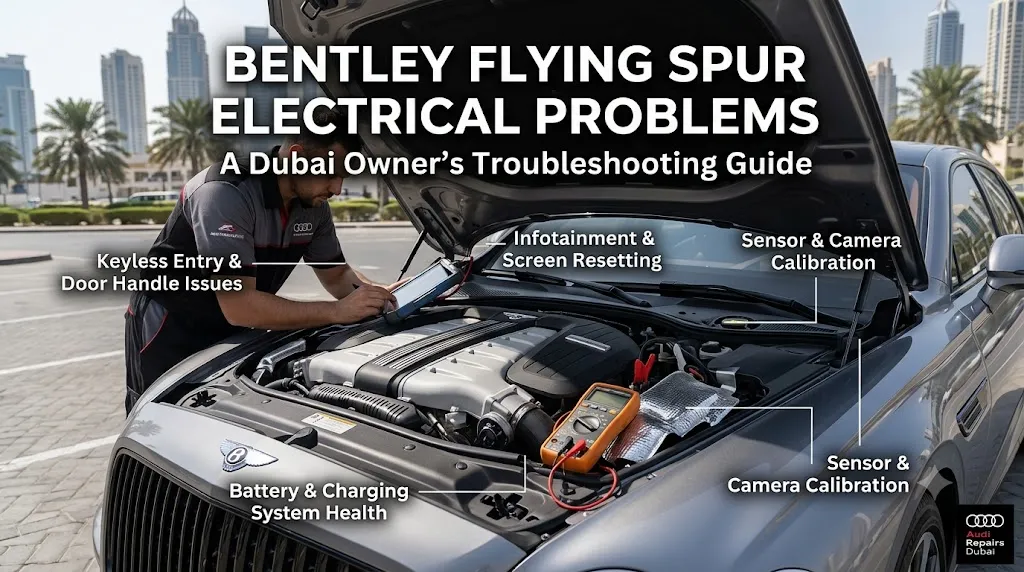
The Bentley Flying Spur is the definitive luxury saloon for many UAE owners — chauffeur-grade rear comfort, effortless W12 or V8 performance, and a cabin dense with technology. But that density of technology is precisely where ageing Flying Spurs (and their Continental siblings) most often frustrate their owners. Electrical and electronic faults are the most commonly reported issue category on these cars, and Dubai’s climate plays a bigger role than most people realise.
The good news: the majority of Bentley “electrical gremlins” trace back to a handful of well-understood root causes. This guide walks through them in the order a professional workshop investigates — which is also the order of cheapest to most expensive.
Start Here: The Battery Is Guilty Until Proven Innocent
It cannot be overstated: a huge proportion of strange Bentley electrical faults are caused by nothing more than a weak or failing battery.
A Flying Spur carries dozens of electronic control modules on multiple data networks. These modules are voltage-sensitive. When battery voltage sags — during cranking, after the car sits for two weeks, or because a five-year-old battery is quietly dying in the heat — modules brown out, log spurious fault codes, and misbehave in ways that look terrifying: random warning lights, gearbox fault messages, suspension warnings, windows resetting, infotainment rebooting, keyless entry failing.
Dubai is brutal on batteries. Heat accelerates internal degradation, and many Bentley owners drive their cars intermittently, letting the substantial standby drain of all those modules pull the battery down between drives. An AGM battery that lasts six years in Europe often lasts three to four here.
The professional approach: before chasing any electrical fault, load-test the battery, check the charging system output, and measure parasitic drain. If your car sits unused for more than a week at a time, a proper maintenance charger is the single best accessory you can buy.
Common Fault #1: Keyless Entry and Door Handle Issues
Flying Spur and Continental owners frequently report doors that won’t unlock from the handle sensor, boot releases that ignore them, or keys that aren’t detected. Causes range from worn handle sensors and broken wiring in the door loom (the harness flexes every time the door opens) to weak key fob batteries and antenna faults. Diagnosis via the comfort system module pinpoints which sensor or antenna is failing, avoiding blind parts replacement.
Common Fault #2: Infotainment, Screens, and Cameras
Older Flying Spurs suffer from slow or rebooting infotainment units, failed screen motors on rotating-display cars, dead pixels, and camera dropouts. Two Dubai-specific accelerants: cabin heat soak (interior temperatures above 70°C in a parked car stress every solder joint and display) and voltage dips from tired batteries during start-up. Many “failed” units are actually software or supply-voltage issues; a workshop with the correct diagnostic platform can update, recode, or in many cases repair units at board level rather than quoting a full replacement.
Common Fault #3: Window Regulators and Soft-Close Motors
Frameless and heavily soundproofed doors mean complex window mechanisms with pinch protection and drop-glass functions. Symptoms include windows that drop slightly and refuse to close fully, soft-close boot or door functions failing, or windows recalibrating themselves. Heat-hardened lubricants and worn regulator cables are common culprits; often the fix is mechanical service and recalibration rather than expensive motor replacement.
Common Fault #4: Sensors, Cameras, and Driver Assistance Warnings
Parking sensors that scream at nothing, adaptive cruise faults, and lane-assist warnings frequently trace back to sand and grime coating sensors, water ingress into front sensor connectors after enthusiastic pressure-washing, or misaligned radar units after minor front-end repairs. These systems require calibration with proper targets and software after any bumper or windscreen work — a step some general body shops skip, leaving owners with permanent warning lights.
Common Fault #5: Module Communication and Wiring Faults
The deepest category. When a control module drops off the data bus, symptoms cascade across seemingly unrelated systems. Root causes include corroded ground points, chafed harnesses (especially in door and boot hinges), moisture in connector plugs, and occasionally genuine module failure. This is where workshop capability separates sharply: a Bentley-experienced technician with factory-level diagnostics reads the network topology, sees exactly which module is silent, and tests power and ground to that module before condemning it. A general workshop without that equipment simply cannot do this job properly — and “try a used module” without correct coding and adaptation usually creates new problems, because modules must be coded to the car.
Why Diagnosis Quality Matters More Than Anywhere Else
On mechanical repairs, an experienced mechanic’s intuition goes a long way. On Bentley electronics, equipment and platform knowledge decide everything. The correct diagnostic system reads all modules, shows live data and network status, performs guided fault-finding, and — critically — codes new components to the vehicle. Without it, workshops resort to parts-cannon repairs at your expense.
When choosing where to take an electrically troubled Flying Spur, ask directly: Do you have Bentley-capable factory-level diagnostics? Can you code and adapt replacement modules? Will you show me the fault-scan report before and after repair? Any genuine bentley specialist dubai will answer yes to all three without hesitation and put it in writing on the job card.
Preventive Habits for Dubai Conditions
- Keep the battery healthy and tested annually — this alone prevents the majority of gremlins
- Use a maintenance charger if the car sits more than a week
- Park shaded or use quality tint to reduce cabin heat soak on electronics
- Be gentle with pressure washers around sensors, cameras, and door seals
- Fix small faults promptly — a single failing module dragging down a data bus can trigger faults in healthy systems
- Get a full-system scan annually even without warning lights; stored fault codes reveal problems building quietly
The Reassuring Truth
Flying Spur electrical faults feel alarming because the car communicates them dramatically — a cascade of warnings on a beautiful high-resolution display. But behind the drama, the causes are usually mundane: a tired battery, a worn sensor, a chafed wire, a software glitch. In experienced hands with the right equipment, these are systematic, solvable problems with predictable costs. The key is choosing diagnosis over guesswork — because on a car with this much technology, guesswork is the most expensive tool in the box.