
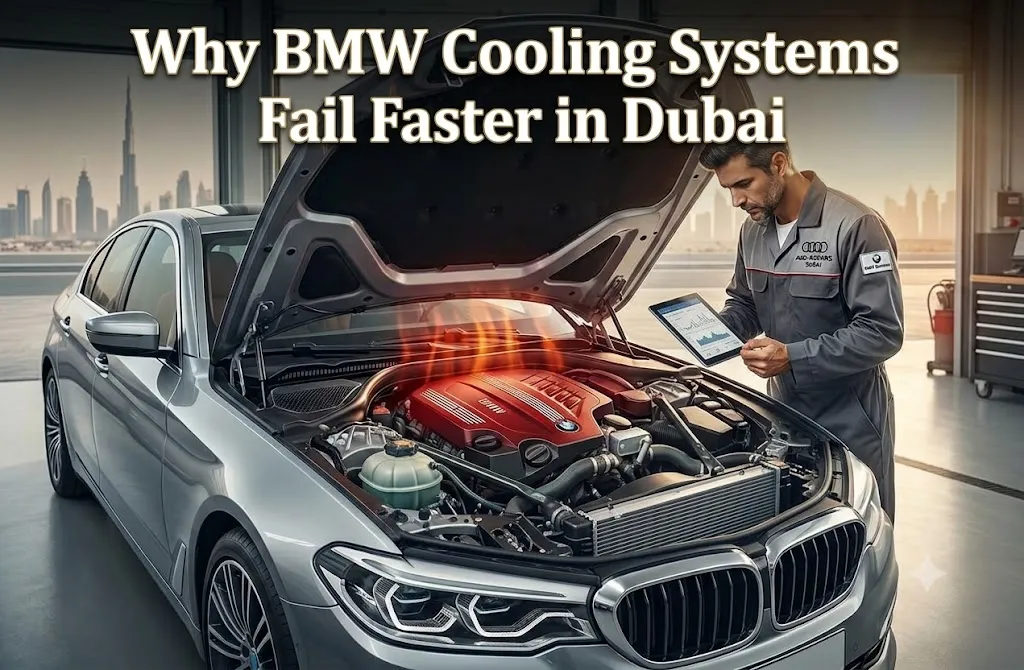
Ask any experienced technician in the UAE which BMW problem they see most often, and cooling system failure will almost always top the list. It is not because BMW builds a weak cooling system — the engineering is actually quite sophisticated — but because the components BMW uses were designed with European ambient temperatures in mind, and Dubai punishes them relentlessly. When the outside air is already 45°C and the asphalt radiates even more heat back at the undercarriage, every plastic fitting, rubber hose, and electric pump in the cooling circuit is working at the very edge of its design envelope.
Understanding why these failures happen, what the early warning signs look like, and what a proper repair involves can save you from the single most expensive outcome in BMW ownership: a warped cylinder head or blown head gasket caused by driving an overheating car even a few kilometres too far.
The Plastic Problem
Modern BMWs — from the E90 3 Series through the current G-series cars — use a significant amount of engineering plastic in the cooling system. The expansion tank, thermostat housing, radiator end tanks, water pump impellers on some engines, and numerous quick-connect fittings are all made of glass-reinforced nylon or similar composites. These materials are light, cheap to manufacture, and perfectly durable in a climate where the cooling system spends most of its life between 20°C and 90°C.
In Dubai, the story is different. Underhood temperatures in stop-and-go traffic on Sheikh Zayed Road during August can exceed 120°C in certain areas of the engine bay. Plastic that cycles repeatedly between extreme heat and rapid cooling becomes brittle over time. The failure is rarely gradual — a brittle expansion tank does not weep slowly for months; it cracks suddenly, dumps coolant in minutes, and leaves you stranded. Most cooling system components that would comfortably last 150,000 km in Germany are realistically good for 80,000–100,000 km in the Gulf, and often less if the car sits outside in the sun.
The Electric Water Pump: Brilliant Until It Isn’t
BMW pioneered the electric water pump on the N52 six-cylinder engine, and variants of it appear across the N54, N55, and other engines. The electric pump is genuinely clever: it allows the engine computer to control coolant flow precisely, improving warm-up times and fuel economy. But the pump contains electronics and brushless motor windings that live in one of the hottest parts of the engine bay.
In Dubai conditions, electric water pump failure between 70,000 and 110,000 km is so common that most experienced workshops recommend replacing it preventively along with the thermostat — the two are usually done together because labour overlaps. The warning signs are subtle: a slightly elevated temperature reading, a fan that runs loudly after shutdown more often than it used to, or an intermittent “Drivetrain: reduced power” message. Once the pump fails completely, the engine can go from normal temperature to critically overheated in under two minutes, which is not enough time to find a safe place to stop on a busy highway.
Radiators, Hoses, and the Auxiliary Circuit
Turbocharged BMWs — which now means almost every BMW sold in the UAE — often have a secondary low-temperature cooling circuit for the intercooler and, on newer cars, the hybrid or 48V electrical systems. This means twice the radiators, twice the hoses, and twice the potential leak points. Sand and fine dust, which are unavoidable in this region, gradually pack into the narrow gaps between the condenser, intercooler radiator, and main radiator. This debris blanket acts as insulation, forcing every component to run hotter and accelerating the ageing of everything around it.
A proper cooling service in this climate should include removing the front bumper or radiator shrouds periodically to clean out compacted sand from between the heat exchangers. It is a labour step many quick-service outlets skip, and it makes a measurable difference — often 5–8°C in operating temperature during summer.
Coolant Itself Matters More Than People Think
BMW specifies a specific coolant formulation (the blue HT-12 in recent years, replacing the older green coolant), and mixing incompatible coolants creates gel-like deposits that clog the heater core and narrow passages in the cylinder head. In the UAE, where topping up with whatever is available at a petrol station is common practice, contaminated coolant is a frequent hidden cause of overheating. Coolant also degrades faster at sustained high temperatures — its corrosion inhibitors deplete, and the electrolysis protection weakens, which quietly eats away at aluminium components from the inside.
A full coolant flush every two years, or roughly every 40,000 km in Gulf conditions, is cheap insurance. Compare the cost of a flush against the cost of a replacement heater core — a job that on many BMWs requires removing the entire dashboard — and the maths is not close.
Warning Signs You Should Never Ignore
There are a few symptoms that should send any BMW owner in the UAE straight to a workshop rather than “waiting to see if it gets worse”:
A coolant smell without a visible puddle. Modern BMWs have underbody panels that catch small leaks, so by the time you see coolant on the ground, the leak is already substantial. The sweet, syrupy smell after parking is often the first sign.
The auxiliary fan running at full speed constantly. The fan compensating for a struggling cooling system is a symptom, not a solution.
Temperature swings on the hidden gauge. Most modern BMWs hide the true coolant temperature, but it can be read through the instrument cluster’s hidden menu or a diagnostic tool. If the reading fluctuates widely during normal driving, thermostat or pump problems are developing.
Coolant level dropping without a visible leak. This can indicate an internal leak — the beginning of head gasket failure — and needs a pressure test and combustion gas test immediately.
What a Proper Repair Looks Like
Because cooling components age together, replacing only the single part that failed is often false economy. If the water pump fails at 95,000 km, the thermostat, expansion tank, and main hoses are the same age and made of the same heat-cycled plastic. A reputable workshop will present this honestly: replace the failed part alone if budget demands it, but understand that the surrounding components are statistically likely to fail within the next year. Many owners choose a complete cooling system overhaul — pump, thermostat, expansion tank, cap, hoses, and fresh coolant — which in the Gulf climate is arguably the single best preventive investment a BMW owner can make.
Genuine or OEM-supplier parts matter here too. The aftermarket is flooded with cheap copies of BMW cooling components, and a counterfeit expansion tank that fails on the highway in July costs far more than the savings ever justified. If you want the work done properly, with pressure testing, correct coolant vacuum-filling (BMW systems are notoriously difficult to bleed by gravity), and genuine parts, it is worth having the system inspected by a dedicated bmw repair dubai workshop that sees these exact failures every single week and knows which components are living on borrowed time in this climate.
The Bottom Line
Dubai is one of the hardest environments on earth for an automotive cooling system. The combination of extreme ambient heat, stop-and-go traffic, sand ingress, and plastic-intensive German engineering means cooling failures are not a question of if, but when. The owners who avoid catastrophic engine damage are the ones who treat the cooling system as a wear item — inspected annually, flushed regularly, and overhauled preventively rather than reactively. Your BMW’s engine is built to last for many hundreds of thousands of kilometres; whether it gets the chance depends almost entirely on the health of the system keeping it cool.