Structural Body Repair

Audi Chassis Straightening Dubai

Audi chassis straightening in Dubai done properly means measuring your car against Audi's own body dimensions, pulling it back to factory tolerance on a dedicated bench and then finishing the panels so nobody can tell it was ever hit. Audi Repair Dubai is an independent, Audi-only body shop with specialist technicians, dealer-level methods and free pickup and drop-off anywhere in Dubai.

Whether a rear-end shunt on Sheikh Zayed Road has pushed a boot floor forward or a hard strike on a kerb has shifted a front subframe mount, we tell you honestly what can be straightened, what must be replaced and what it will take to make your Audi drive straight again.

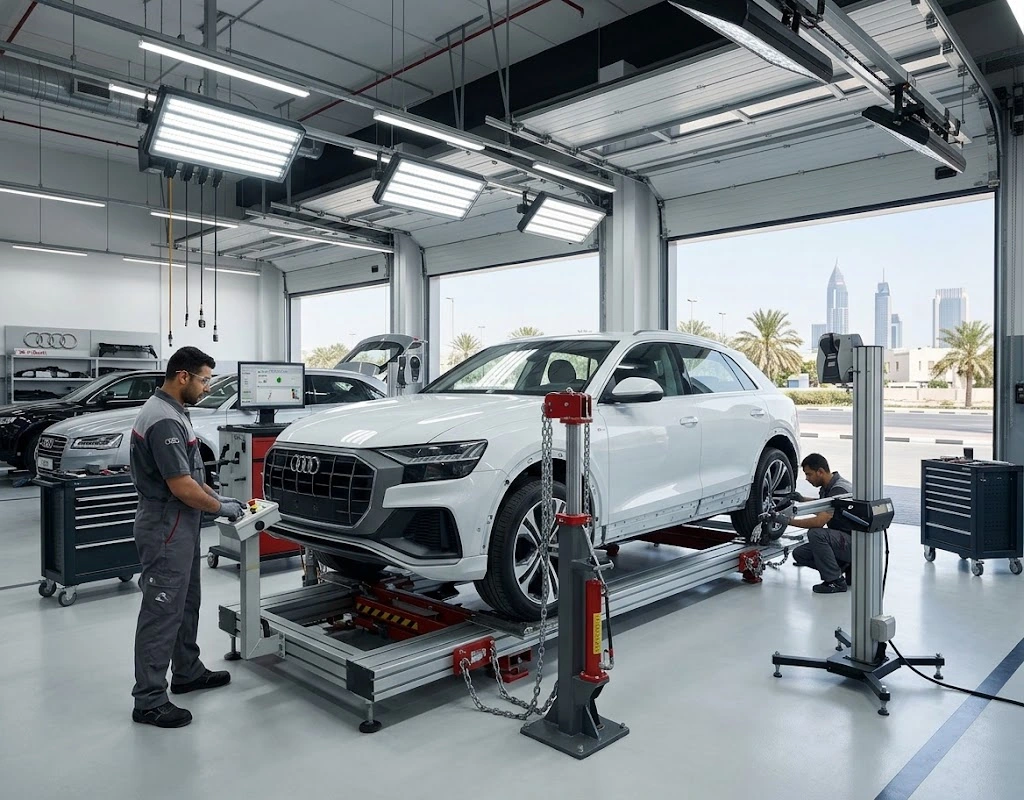
Audi chassis straightening Dubai – Audi body mounted on a frame straightening bench with 3D measuring arms

Why It Matters

What Audi Chassis & Body Straightening Really Involves

Table of Contents

Most people picture body repair as filling a dent and spraying a panel. Chassis and body straightening is a different job altogether. It deals with the structure underneath the paint: the chassis legs, sills, pillars, floor pan, strut towers, crossmembers and the mounting points that locate your suspension, steering and engine. When any of those points move even a few millimetres out of position, the car can look fine from the outside yet drive, wear tyres and protect its occupants very differently.

Every Audi leaves the factory with a precise set of body dimensions. Engineers publish measuring points, usually holes, bolts and reference surfaces on the underbody and inside the engine bay, together with the exact distance between them. A proper Audi chassis straightening job starts by comparing your car to that data, not by eye. If the front left chassis leg is sitting 9 mm lower than it should, that number tells us where to anchor the car, which direction to pull, and when to stop.

For Audi chassis & body straightening in Dubai, Audi Repair Dubai treats structure first and cosmetics second. Once the shell is back within tolerance, our paint team finishes the outer panels to the exact Audi paint code so the repair disappears. That combination, correct geometry underneath and an invisible finish on top, is what protects both your safety and the resale value of your car.

Why a Proper Repair Protects Resale Value

The Dubai used-car market is sharp. Buyers and dealers routinely run a paint thickness gauge over every panel, check panel gaps along the bonnet and doors, look for overspray on rubber seals and ask for an inspection report before they commit. A car with an obvious respray, uneven shut lines or a steering wheel that sits off-centre loses thousands of dirhams at trade-in, even if it was repaired after a minor incident.

A correctly straightened Audi gives a very different story. Door gaps line up. The bonnet closes flush. The car tracks straight with the wheel centred. Tyres wear evenly. Paint readings are consistent across blended panels. When a buyer's inspector puts it on a lift, the underbody looks tidy, sealed and protected rather than scarred with pull marks and bare metal. That is the finish we work towards on every car.

Why It Matters for Safety

Modern Audis are designed to absorb crash energy in a controlled way. Crumple zones fold in a planned sequence, while the passenger cell is built from ultra-high-strength steel to stay rigid. If a damaged structure is pulled carelessly, heated where it should not be heated, or left slightly out of line, the car may not behave the way it was designed to in a second impact. Airbag sensors, seatbelt pretensioners and driver-assistance cameras all rely on the body being where the engineers expected it to be.

That is why we never promise to “straighten anything”. Some parts are made to be repaired; others, particularly hot-formed steel in the pillars and roof rails, must be replaced by sectioning at approved joins. Telling you the difference, clearly and before any money is spent, is part of the service.

Signs And Situations

When Audi Owners Need Straightening

Structural damage is not always obvious. Some Audis arrive with a crumpled front end; others look nearly perfect but pull to one side and chew through a new set of tyres in a few thousand kilometres. These are the situations we see most often in Dubai, from the most severe to the ones owners tend to ignore.

Front & Rear Collisions

Nose-to-tail impacts in slow traffic on Al Khail Road or Emirates Road often push crash boxes, bumper reinforcements and chassis legs back. Behind an intact-looking bumper there can be a buckled radiator support or a leg that has moved rearward.

Side Impacts

A T-bone at a junction or roundabout loads the B-pillar, sill and floor crossmembers. Doors that no longer shut cleanly, a sill with a visible ripple or a seat that sits oddly are warning signs of structural movement.

Heavy Kerb & Pothole Strikes

Clipping a high kerb or a raised drainage edge at speed can bend a wishbone, then go further and shift a subframe or strut tower. If a new alignment will not bring the car back into spec, the body is likely out of position.

Desert & Dune Driving

Q5, Q7 and Q8 owners heading to Al Qudra or the dunes near Lahbab sometimes land hard or ground out on a crest. The result can be a bent rear crossmember, crushed sill or a damaged jacking point that needs proper straightening.

Parking Structure Damage

Tight spiral ramps and concrete pillars in mall and tower car parks cause more than scratches. A firm hit on a rear quarter at low speed can distort the wheel arch, rear light aperture and the inner quarter structure behind it.

Previous Poor Repairs

We regularly see Audis bought second-hand that were “repaired” elsewhere with no measuring. Uneven gaps, cracked seam sealer, heat-blued metal and persistent pulling are the giveaways. We can measure, correct and refinish them properly.

Cosmetic Damage That Comes With Structural Work

Structural jobs rarely come alone. Alongside the straightening, most cars also need attention to the damage owners notice first: parking dents on doors and wings, deep scratches that have gone through the clear coat, kerbed and cracked bumpers, scuffed sills and mirror caps. In Dubai, we also see a lot of sun-faded paint on roofs, bonnets and bootlids, especially on darker colours and older cars that have lived outdoors.

Because we have the car on the bench already, it makes sense to handle those at the same visit. Everything is finished to one standard, colour matched in one session and blended so the old and new paint sit side by side without a visible line.

Quiet Warning Signs You Should Not Ignore

  • The car pulls or wanders even after a fresh wheel alignment, or the alignment technician says the settings cannot be brought within range.
  • The steering wheel sits off-centre when you drive in a straight line on a flat road.
  • Uneven or rapid tyre wear on one corner, especially on the inside edge.
  • Panel gaps have changed: a bonnet sitting higher on one side, a door that needs slamming, a bootlid that rubs.
  • Wind noise or water leaks around a door or windscreen that were never there before.
  • Driver-assistance faults such as adaptive cruise, lane assist or parking cameras reporting errors after an impact.
  • Creaks over speed bumps from a corner that took a hit, which can indicate a stressed mounting point.

If you recognise any of these after an incident, send us photos on WhatsApp. We will tell you whether it sounds like a simple alignment issue or something that needs measuring on the bench.

How We Work

Our Audi Chassis & Body Straightening Process

A structural repair succeeds or fails on method. This is the sequence we follow on every Audi, from a single bent chassis leg to a car that needs a full front end rebuilt. Each stage has a reason, and none of them is skipped to save time.

1

Assessment & Damage Mapping

We start with a road test where it is safe to drive, then a full visual inspection on a lift. Trim, bumpers and liners are removed as needed to expose the structure. We scan every control module for crash data, airbag and restraint faults and driver-assistance errors, and record every item of damage with photographs so you see exactly what we see.

2

3D Measuring Against Audi Data

The car is set up on a straightening bench and measured with an electronic measuring system at the reference points specified for that exact model. The report shows each point's deviation in length, width and height. This is the evidence that tells us whether straightening is needed, how much and in which direction.

3

Anchoring the Body

The shell is clamped at the sill pinch welds or the model-specific fixing points so it cannot move as a whole when force is applied. Correct anchoring is critical: without it, pulling one corner simply drags the whole car and distorts undamaged areas.

4

Controlled Hydraulic Pulling

Using hydraulic towers and chains, we pull in multiple directions at once, reversing the path the impact took. Measurements are checked live throughout. Pulls are staged with pauses and stress relief so the metal returns to shape rather than being forced past it. On aluminium components we use dedicated tools and avoid uncontrolled heat.

5

Repair or Replace Structural Parts

Where a section is kinked, torn or made from hot-formed high-strength steel that should not be straightened, we cut it out at approved sectioning points and fit a new part using the joining method intended for that area, such as spot welding, MIG brazing or rivet bonding. New joints are corrosion protected and seam sealed.

6

Panel Preparation

Once the structure measures correctly, outer panels are fitted and gapped. Repairable dents are worked out, then panels are keyed, filled only where genuinely necessary, primed with a high-build primer and block-sanded flat under inspection lights until no ripple remains.

7

Factory Colour Matching

We read the Audi paint code from the vehicle data label, mix to that formula and then check it against your car's actual paint with test cards in daylight-balanced light. Formulas are fine-tuned because real-world paint shifts with age and sun exposure.

8

Spray Booth Application

Base coat and clear coat go on inside a dust-controlled, filtered spray booth. That keeps airborne sand and dust, a real challenge in Dubai, out of the finish and gives even film build across large panels like roofs and bonnets.

9

Curing

The booth is brought up to temperature to bake the clear coat so it cross-links fully. Proper curing gives the hardness and gloss that stand up to UV, car washes and desert heat, rather than a soft finish that marks easily for weeks.

10

Blending

Colour is faded into adjacent panels so there is no hard line where new paint meets original. On metallic and pearl colours such as Glacier White, Mythos Black or Navarra Blue, blending is what keeps the flake looking identical from every angle.

11

Polishing & Reassembly

After curing, the new clear coat is flatted to remove any texture or dust nibs and machine polished to match the gloss of the factory paint around it. Trim, lights, sensors and liners are refitted with new clips where needed.

12

Alignment, Calibration & Quality Check

We finish with a four-wheel alignment, driver-assistance calibration where cameras or radar were disturbed, a fault-code clear and final scan, a road test and a detailed panel-by-panel inspection. Only then do we arrange delivery back to you.

Why Measuring Before and After Matters

We keep the pre-repair and post-repair measurements. Before, they justify the work and show you honestly how far the structure had moved. After, they prove the body is back within tolerance. If you later sell the car, that record is useful evidence that the repair was carried out correctly rather than by guesswork.

Colour Matching And Paint Quality

An Invisible Finish Over a Straight Body

Once the structure is right, the paintwork is what everyone actually sees. A repair that measures perfectly but shows a slightly different shade on the front wing will still hurt your car's value and your enjoyment of it. Our paint process is designed around one goal: nobody should be able to point to the repaired panel.

Starting From the Exact Audi Paint Code

Every Audi carries a vehicle data sticker, usually in the spare wheel well or service book, that lists its paint code. That code gives us the manufacturer formula. It is the starting point, not the finish line. The same Daytona Grey from two different production years, or two cars that have spent different amounts of time parked in the sun at a JLT tower or a Mirdif villa, can look noticeably different side by side.

So we spray test cards, let them flash off and compare them against a clean, polished area of your car under daylight-balanced lamps and outdoor light. If the match is not right, the formula is adjusted and a new card is sprayed. For three-layer pearl colours and matte finishes the process takes longer, and we plan for that rather than rushing it.

Manufacturer-Matched Paint Systems

We use premium, professional-grade base coat and clear coat systems formulated to match manufacturer colours, not bargain materials that look acceptable on day one and dull within a summer. Quality clear coat matters enormously in the UAE, where surface temperatures on a dark roof can climb high enough to soften cheap lacquer and UV slowly breaks down pigments.

Seamless Blending for Metallics & Pearls

Metallic and pearl paints contain tiny flakes that reflect light. How those flakes lie depends on spray gun distance, air pressure and film thickness, which is why a perfectly mixed colour can still look wrong if it simply stops at a panel edge. We fade new base coat into the neighbouring panel and clear the whole area, so the eye has no hard edge to catch. On a door repair that might mean blending into the front wing and rear door; on a quarter panel, into the rear door and bootlid edge.

Protecting the Structure Under the Paint

What you cannot see is just as important. Any area exposed during straightening or part replacement gets the right corrosion protection: weld-through or anti-corrosion primer on joins, seam sealer in the factory pattern, stone-chip coating on sills and wheel arches, and cavity wax injected inside closed sections. Skipping these steps is how a repaired car develops hidden rust years later, even in a dry climate, because coastal humidity and car-wash water still find their way in.

Matte, Black-Optic & Special Finishes

Many S, RS and S line cars wear gloss black trim, matte grilles or special colours. Matte and satin paint cannot be polished to hide imperfections, so it must be applied correctly in one pass. We treat these finishes with the extra preparation they need and match sheen levels as well as colour.

Models We Cover

Every Petrol Audi, From A1 to R8

We work exclusively on Audi, which means our team is familiar with how each generation is built, where its measuring points are and which parts of its structure can be repaired. We cover every petrol Audi model, including the full S and RS range.

  • A1
  • A3
  • A4
  • A5
  • A6
  • A7
  • A8
  • S3
  • S4
  • S5
  • S6
  • S7
  • S8
  • RS3
  • RS4
  • RS5
  • RS6
  • RS7
  • TT
  • TTS
  • TT RS
  • R8
  • Q2
  • Q3
  • Q5
  • Q7
  • Q8
  • SQ5
  • SQ7
  • SQ8
  • RS Q3
  • RS Q8

Compact Audis: A1, A3, S3, RS3, Q2, Q3

These cars share a largely steel monocoque with high-strength steel in the passenger cell. Front-end damage from low-speed city collisions is the most common repair. We pay close attention to crash boxes, front bumper beams and the lower chassis legs, which are designed to be replaced after an impact rather than stretched.

A4, A5, S4, S5, RS4, RS5, Q5, SQ5

These models mix steel grades and, depending on generation, use aluminium for some outer panels. Straightening must account for different materials behaving differently under load. Accurate strut tower and subframe mount measurements are especially important on quattro versions for proper handling and tyre wear.

A6, A7, A8, S6–S8, RS6, RS7

Larger Audis use more aluminium and, on the A8, an aluminium-intensive Audi Space Frame. Aluminium does not tolerate the rough heat-and-pull methods sometimes used on old steel cars. We use separate aluminium tools to avoid contamination and follow controlled repair and replacement methods.

Q7, Q8, SQ7, SQ8, RS Q8

These heavy SUVs carry a lot of mass into any impact, and many are driven off-road around Dubai. Air suspension and complex driver-assistance sensors mean post-repair ride height checks and calibration are essential parts of the job, not optional extras.

TT, TTS & TT RS

The TT uses a hybrid of aluminium and steel construction. Its low nose and short overhangs make it vulnerable to kerb and ramp strikes. Sectioning and joining must follow the correct method for each material where they meet.

Audi R8

The R8 is built around an aluminium space frame with carbon-fibre-reinforced components on later cars. Repairs demand careful measuring, precise part replacement and specialist finishing. We will always assess an R8 in detail and explain the options before recommending any work.

Parts And Panels

The Right Panels for Your Repair

Straightening restores the structure you already have, but most accident repairs also need some new parts, whether that is a crash box, a bumper reinforcement, a headlight bracket or an outer wing. We can arrange everything your repair requires, so you never have to chase suppliers yourself.

Genuine Audi

Best for structural and safety-related components, and for owners who want the car kept as original as possible.

Quality Aftermarket

A sensible choice for some non-structural items, such as certain brackets, liners or trim, where a reputable alternative fits properly and saves money.

Quality Used

Useful for hard-to-source or expensive panels on older models, such as a used door in the right colour, inspected before fitting.

For structural members like chassis legs, pillars and sills, we recommend genuine parts because their steel grade and dimensions are critical to crash performance. For everything else, we explain the trade-offs in plain terms and let you decide. Your quote lists each part and its type, so there are no surprises.

Why Choose Us

The Smarter Alternative to a Dealer Body Shop

We are an independent Audi body shop in Dubai, not an authorized Audi dealer. What we offer is the same care and method you would expect at a dealer body shop, delivered by a team that only works on Audis, at a price that is typically far lower. For many owners, particularly those whose cars are outside warranty or who are paying for repairs themselves, that combination makes us the best Audi chassis straightening specialist in Dubai for their situation.

What mattersAudi Repair DubaiTypical dealer body shop
Brand focusAudi only, every dayAudi, often alongside other brands in the group
Structural methodBench anchoring and 3D measuring against Audi dataSimilar methods
PriceUp to 70% cheaper than the authorized dealershipDealer labour rates and parts pricing
Parts choiceGenuine, quality aftermarket or used, explained openlyGenuine parts as standard
Collection and deliveryFree pickup and drop-off anywhere in DubaiVaries by dealer and location
Who you speak toThe people repairing your car, directly on WhatsAppService advisor relaying messages
PaymentSimple, direct, customer-paid jobsOften routed through insurance processes

Simple, Direct-Paid Service

We do not work with insurance companies. Every job is agreed and paid for directly by the customer. That keeps things straightforward: no waiting for surveyor approvals, no disputes over which parts are “covered” and no pressure to use the cheapest possible repair method to satisfy a claim. You approve the quote, we do the work to our standard, and you pay us directly.

Many owners choose this route for smaller structural repairs anyway, to protect their no-claims history, or because their policy would not cover the full cost of a proper repair.

Honest Advice, Even When It Costs Us Work

Some cars should not be straightened. If the passenger cell is badly compromised or the total repair would exceed a sensible share of the car's value, we will say so. We would rather lose a job than return a car we are not confident in. That honesty is a big part of why owners come back and recommend us.

Audi Only

Technicians who know Audi structure, materials and systems.

Measured Repairs

Before-and-after data, not guesswork.

Work Guarantee

Our workmanship is guaranteed, with terms in writing.

Free Pickup

Collection and delivery across all of Dubai.

Cost Factors

Audi Chassis Straightening Cost in Dubai

The honest answer to “how much does Audi chassis straightening cost in Dubai?” is that it depends on what has moved and by how much. A car that needs one corner pulled back a few millimetres is a very different job from one with a replaced chassis leg, a new radiator support and three panels to paint. Rather than quote a misleading headline price, we explain exactly what drives the figure and give you a clear, itemised quote after inspection.

FactorHow it affects the price
Extent of structural damageThe number of measuring points out of tolerance, and how far, determines bench time and the complexity of the pulls.
Repair versus replacementStraightening an existing part costs labour; sectioning in a new chassis leg or pillar adds parts, joining work and corrosion protection.
MaterialsAluminium and mixed-material structures on larger Audis and the R8 need dedicated tools and more time than conventional steel.
Panel size and numberA mirror cap or bumper corner is far quicker to paint than a roof, bonnet or full side of the car.
Paint colourSolid colours are the simplest. Metallics need blending; three-layer pearls and matte finishes need more material and more time.
Finish levelBlending into adjacent panels, full panel clearing and multi-stage polishing all add to labour but give a far better result.
Parts choiceGenuine, quality aftermarket or used parts have very different prices for the non-structural items.
Driver-assistance systemsRadar, cameras and sensors disturbed by the damage or repair need calibration afterwards.
Hidden damageOccasionally stripping a car reveals more damage. We stop, show you photos and requote before doing anything extra.

How to Get an Accurate Quote

Send clear photos of the damage on WhatsApp, including wide shots of the whole side, close-ups of the damaged area, the wheel on that corner and the vehicle data sticker if you can find it. We can usually give you a realistic range from photos. For structural work, a firm quote follows once the car has been measured, which we can arrange by collecting it at no cost.

Affordable Without Cutting Corners

Affordable Audi chassis straightening in Dubai does not mean doing less. Our lower pricing comes from independent overheads and flexible parts sourcing, not from skipping measuring, cavity wax or calibration. The steps that keep your car safe are never where we save money.

Free Pickup And Drop-Off

We Collect Your Audi, Free, Anywhere in Dubai

A car with structural damage is not always one you want to drive across the city, and your time is valuable. That is why pickup and drop-off are free for customers anywhere in Dubai. Searching for Audi chassis straightening near me no longer means settling for the closest garage; the right Audi chassis straightening shop in Dubai comes to you.

1

Message Us

WhatsApp photos and your location, or call +971 52 791 4606.

2

We Collect

We agree a time and collect from your home, office or car park.

3

Inspect & Quote

You receive measurements, photos and an itemised quote to approve.

4

We Deliver

After final checks, your Audi comes back to your door.

What If the Car Is Not Drivable?

If the damage means the car should not be driven, for example a wheel pushed back, a leaking radiator or airbags deployed, let us know when you get in touch. We will arrange suitable transport on a recovery truck so the car is moved safely, and confirm the arrangements with you in advance.

Throughout the repair we send progress updates and photos on WhatsApp, so you can see your car on the bench, the measurement results and the paint stages without having to visit.

Areas We Serve

Serving Audi Owners Across Dubai

Our free collection covers the whole emirate. Whether your Audi lives in a villa garage in Arabian Ranches or a tower car park in Business Bay, we can collect it. Areas we regularly serve include:

  • Downtown Dubai
  • Business Bay
  • Dubai Marina
  • Jumeirah Beach Residence
  • Jumeirah Lake Towers
  • Palm Jumeirah
  • Jumeirah
  • Umm Suqeim
  • Al Barsha
  • Al Quoz
  • Emirates Hills
  • The Springs & Meadows
  • Arabian Ranches
  • Dubai Hills Estate
  • Motor City
  • Sports City
  • Jumeirah Village Circle
  • Damac Hills
  • Mirdif
  • Deira
  • Bur Dubai
  • Al Karama
  • Dubai Silicon Oasis
  • International City
  • Dubai Festival City
  • Al Warqa
  • Discovery Gardens
  • Dubai South
  • Jebel Ali
  • Town Square

Not on the list? If you are anywhere in Dubai, the offer stands. Different parts of the city bring different kinds of damage too. Marina and JLT owners often come to us after tight car park incidents; Al Qudra and Dubai South drivers with off-road or highway damage; Deira and Bur Dubai owners after low-speed city traffic collisions. Wherever you are, the process and the finish are the same.

Frequently Asked Questions

Audi Chassis Straightening FAQs

Straight answers to the questions Dubai Audi owners ask us most about structural straightening, body repair and paint.

How much does Audi chassis straightening cost in Dubai?

It depends on how far the structure has moved, whether parts can be straightened or must be replaced, the materials involved, how many panels need painting and your paint colour. We give a realistic range from WhatsApp photos and a firm, itemised quote after measuring, typically up to 70% below authorized dealership pricing.

How long does chassis and body straightening take?

A minor pull with one or two panels painted can take a few working days. Jobs that involve replacing structural sections, several painted panels or waiting for parts take longer. We give you a realistic timeline with your quote and keep you updated if anything changes.

How do I know if my Audi's chassis is bent?

Common signs include the car pulling after an alignment, an off-centre steering wheel, uneven tyre wear, changed panel gaps, doors that are hard to close and new wind noise or leaks. The only way to be certain is to measure the body against Audi's reference dimensions on a bench, which we can arrange.

Can a bent Audi chassis be repaired safely?

In most cases, yes. Correct anchoring, controlled pulling and measuring bring the structure back to factory tolerance, and damaged sections that should not be straightened are replaced at approved joins. If a car is too badly damaged to repair safely or economically, we tell you honestly.

Will the colour match the factory paint exactly?

We mix from your car's Audi paint code, spray test cards and compare them to your actual paint, adjusting the formula for age and sun fade. We then blend into adjacent panels so there is no visible transition, even on metallic and pearl colours.

Do you guarantee or warranty the paintwork?

Yes. We guarantee our workmanship on straightening, body repair and paintwork. The terms of the guarantee for your specific job are confirmed in writing with your quote, before any work begins.

Do you repair or replace damaged panels?

We repair wherever a repair will be as good as the original, because it saves you money and keeps factory panels on the car. Where a panel is torn, stretched, or a structural part is made from steel that should not be straightened, we replace it and explain why.

Do you handle accident damage?

Yes. We handle everything from minor front and rear impacts to significant collision damage involving chassis legs, sills, pillars and floors, including the related bodywork, paint, alignment and driver-assistance calibration.

Do you work with insurance companies?

No. We do not work with insurance companies. All our jobs are direct and customer-paid, which keeps the process simple, fast and focused on the right repair rather than on claim approvals.

Do you collect and deliver the car?

Yes. Pickup and drop-off are free anywhere in Dubai. If your Audi is not safe to drive, tell us and we will arrange suitable transport for it.

Which Audi models do you cover?

Every petrol Audi model: A1 to A8, the full S and RS range, TT, TTS, TT RS, R8, and the Q range including Q2, Q3, Q5, Q7, Q8, SQ5, SQ7, SQ8, RS Q3 and RS Q8.

What payment options do you offer?

Payment is made directly by you, the customer, once the work is complete and you are happy with it. Let us know how you would prefer to pay when you book and we will confirm the accepted methods for your job.

Do you do full body resprays?

Yes. As an Audi paint and body shop in Dubai, we carry out full resprays in the original colour, for example on cars with widespread sun fade or many repaired panels. Doors, shuts and edges are properly prepared so the finish looks factory rather than resprayed.

How do you protect the new paint?

The clear coat is baked in the booth to cure fully, then polished. We advise hand washing only and avoiding polishes and waxes for the first few weeks. Paint protection film or ceramic coating can be applied afterwards for extra defence against sand, stone chips and UV.

Do you recalibrate driver-assistance systems after the repair?

Yes. If radar sensors, windscreen cameras or parking sensors were removed or affected, we calibrate them after the structural and paint work, then carry out a wheel alignment, fault scan and road test before returning the car.

Book Your Inspection

Get Your Audi Straight Again

Send us photos of the damage on WhatsApp for a fast, honest assessment from Dubai's Audi-only body shop. Free pickup and drop-off anywhere in Dubai, measured structural repairs and a finish that protects your car's value.

+971 52 791 4606
Call Now