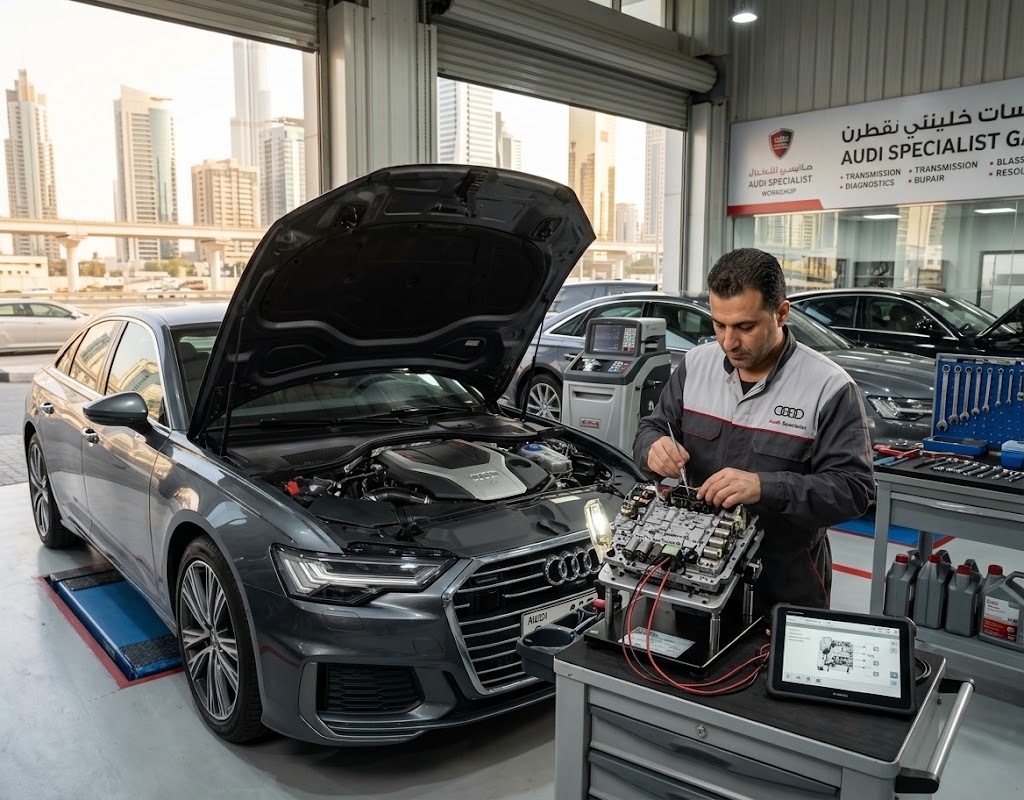
What The Job Involves
What Is Audi Mechatronic Unit Repair?
If your Audi has started hesitating between gears, jolting on the move, or dropping into limp mode on Sheikh Zayed Road, there is a good chance the mechatronic unit is at the heart of it. Audi mechatronic repair in Dubai is one of the most common — and most misunderstood — transmission jobs we handle, and getting it done properly by an Audi specialist can save you from an unnecessary full gearbox replacement.
The mechatronic unit is the electro-hydraulic "brain" of your Audi's dual-clutch transmission. On S tronic and DSG gearboxes it combines a valve body, a set of solenoids, hydraulic pistons, pressure sensors and a Transmission Control Module (TCM) into a single sealed assembly that sits inside or on top of the gearbox. Every gear change your car makes is decided and executed here: the control module reads throttle position, road speed, clutch temperature and driver input, then commands the solenoids to route hydraulic pressure to the correct clutch pack and gear actuator. When the mechatronic unit is healthy, all of this happens in a few milliseconds and you barely feel it. When it starts to fail, the whole driving experience falls apart.
Audi has used several transmission families over the years — the 7-speed dry-clutch DQ200 (0AM/0CW), the 6-speed wet-clutch DQ250 (02E), the 7-speed wet-clutch DQ500 and the DL501 (0B5) S tronic fitted to longitudinal quattro models. Each has its own mechatronic design, its own characteristic faults and its own repair approach. A generic "gearbox garage" that treats them all the same tends to get it wrong. Because we work exclusively on Audi, we know which unit is in your car, what typically goes wrong with it in the Dubai climate, and whether it can be repaired, reconditioned or needs replacing.
The Dubai environment is genuinely hard on these units. Sustained 45°C-plus summer heat, stop-start traffic on the way into Business Bay, and constant low-speed crawling all push transmission fluid temperatures higher and for longer than the mild European conditions these gearboxes were validated in. Heat degrades the transmission fluid, cooks the solenoid seals, and stresses the soldered joints inside the control module. That is why we see mechatronic faults on Audis here earlier and more often than the mileage alone would suggest — and why a proper repair also addresses fluid condition and cooling, not just the failed part.
The specific failure also tends to follow the gearbox family. On the dry-clutch DQ200 fitted to many A1 and A3 models, it is often the mechatronic accumulator, the pressure sensors or the control-module electronics that give trouble first. On the wet-clutch DQ250 and DQ500 units, worn solenoids, tired clutch adaptation and contaminated fluid are the usual culprits. On the DL501 S tronic behind the bigger quattro cars — the A4, A5, A6, A7, Q5 and their S and RS derivatives — it is frequently valve-body wear and internal leaks that upset shift quality. Knowing these patterns in advance is exactly what lets us diagnose faster and repair more precisely than a general workshop ever could.