Audi Body & Paint Specialists

Audi Accident Repair Dubai

Dedicated Audi accident repair Dubai owners can trust for panel work, structural straightening and factory-matched paint. We are an independent Audi-only body shop delivering a dealer-level finish at far better value, with free pickup and drop-off anywhere in Dubai.

From a kerbed S5 bumper in Business Bay to a full quarter panel rebuild on a Q7, our technicians work on Audi bodyshells every single day. Every repair is colour-matched to your car's exact Audi paint code, baked in a controlled spray booth and blended into the surrounding panels so the repair simply disappears.

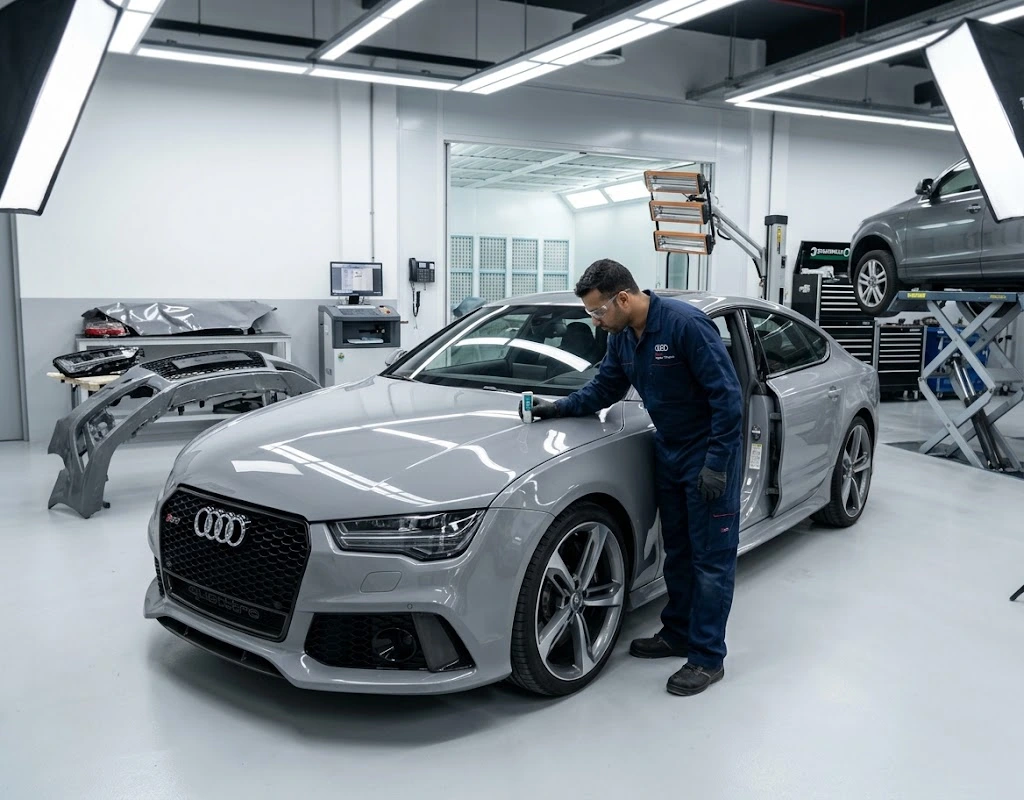
Audi accident repair Dubai technician refinishing a damaged Audi body panel in a spray booth
Why The Finish Matters

Audi Accident Repair In Dubai — Protecting Looks And Resale Value

An Audi is bought as much for how it looks as for how it drives. The tight, consistent panel gaps, the deep lustre of a metallic finish under Dubai sunlight, the crisp shoulder line that runs from the headlight to the tail lamp — these are the details that make the car feel expensive every time you walk up to it. A poor accident repair destroys all of that in a way that no amount of engine work can compensate for. That is why Audi accident repair Dubai owners rely on has to be judged by one standard only: can anyone tell the car was ever damaged?

We are Audi Repair Dubai, an independent Audi-only garage with mechanics and bodywork technicians who work on nothing else. Our paint and body side exists for a specific reason. Audi's body construction, its paint chemistry and its multi-coat finishes behave differently to a mainstream car, and the difference shows up most clearly after a repair. Aluminium-intensive structures on the A8 and Q7 cannot be pulled and welded like ordinary steel. Audi's pearl effect and tri-coat finishes such as Floret Silver, Glacier White, Mythos Black and Tango Red need layered application rather than a single colour pass. Get any of that wrong and the repaired panel will always read slightly different to the eye, particularly in the hard, high-angle light we get here from April through September.

Resale is the second reason a proper repair matters so much in this market. Dubai's used car buyers are unusually well informed. Before money changes hands, most cars go through an inspection, a paint depth gauge reading, or at minimum a careful walk-around in daylight by someone who knows what to look for. Thick paint readings on a door, overspray on a rubber seal, a bumper whose colour sits half a shade off the wing, orange peel texture that does not match the factory panels next to it — every one of those findings becomes a bargaining chip that knocks thousands of dirhams off your asking price. A repair done properly reads as factory paint and costs you nothing at sale time.

There is also a practical, climate-driven argument. Dubai is genuinely hostile to paintwork. Surface temperatures on a dark bonnet parked outside in July can climb far above anything European paint systems were designed around, ultraviolet exposure is intense and year-round, and the fine airborne dust from the desert behaves like a mild abrasive every time it is wiped off a dry panel. Add coastal humidity and salt carried inland from the Gulf, and any repair that leaves bare metal poorly sealed, primer under-cured or clear coat too thin will begin to fail within a couple of summers. Edge lifting, clear coat peeling in sheets and rust blooming from an unprotected repair seam are all things we see regularly on cars that were repaired quickly and cheaply elsewhere.

Our approach is the opposite of quick and cheap. We assess the damage properly, prepare the substrate correctly, mix paint to your car's specific factory code rather than a generic approximation, cure it under controlled conditions and blend it into adjacent panels so there is no visible transition. Then we check the result the same way a buyer or an inspector will — outside, in daylight, from several angles. That process is why customers travel to us from across the city, and why we offer free pickup and drop-off so you never have to drive a damaged car through Dubai traffic to reach us.

We work on a direct, customer-paid basis only. We do not deal with insurance companies, which keeps the whole thing simple: you tell us what you want done, we quote it, you approve it, we do it. No claims handlers, no assessors deciding which parts you are allowed, no six-week waits for authorisation on a car you need for work on Monday.

When You Need Us

Damage We Repair — From Car Park Scuffs To Collisions

Most of the cars that come through our body shop have not been in a dramatic accident. They have been lived with in a dense, fast-moving city where a moment's inattention in a mall car park costs a bumper corner. Here is the damage we deal with most often, and what each one actually requires.

Collision Damage

Front, rear or side impact affecting bumpers, wings, doors, bonnet or tailgate. We assess whether panels can be repaired or need replacing, check the structure behind them, and rebuild the car so panel gaps and shut lines return to factory tolerance.

Parking Dents & Door Dings

The single most common job we see. Shallow dents where the paint is unbroken can often be worked out without refinishing at all. Where the paint has cracked or creased, the panel is filled, primed and resprayed with a blend into the adjacent panel.

Scratches & Key Marks

Light scratches that have not cut through the clear coat can be machine polished out. Deeper scratches down to primer or metal need proper filling and refinishing — polishing a scratch that has broken the clear coat only thins the protection further.

Kerbed Bumpers & Skirts

Low front lips on S and RS models, plus the deep side skirts on the A5 and A7, take a beating from ramps and kerbs. Plastic is plastic-welded or filled where it has split, then refinished — including the satin and textured lower sections.

Sun-Faded & Peeling Paint

Roofs, bonnets and boot lids take the worst UV load in Dubai. Once clear coat starts to cloud, flake or peel, polishing will not save it — the panel needs stripping back and refinishing with fresh base and clear.

Stone Chips & Bonnet Pitting

Sheikh Zayed Road and the E311 at speed will pepper a bonnet and front bumper over time. Individual chips can be touched in; widespread pitting is best solved by refinishing the whole panel for an even, consistent result.

Hail, Impact & Falling Object Dents

Multiple shallow dents across a roof or bonnet from debris or a site incident. Depending on depth and paint condition, these are either worked out from behind or the panel is filled and refinished as a whole.

Mismatched Previous Repairs

We are frequently asked to correct someone else's work — a door that sits a shade off, a bumper with visible tape lines, or filler that has shrunk and telegraphed through. These are stripped back and redone properly.

Pre-Sale Cosmetic Restoration

Selling the car and want it to inspect cleanly? We tidy up the accumulated kerb rash, dings and scuffs so the car presents as a well-kept example rather than a project someone can haggle down.

If you are unsure which category your damage falls into, send us clear photos on WhatsApp. In most cases we can tell you straight away whether the panel needs polishing, filling and blending, or replacing — and roughly what is involved before you commit to anything.

Our Repair Process

How We Carry Out Audi Accident Repair, Step By Step

Body and paint work is unforgiving because every stage depends on the one before it. Rushed preparation cannot be rescued by good paint, and perfect paint applied over poorly cured primer will fail within a year. This is the sequence we follow on every car, whether it is a scuffed A3 bumper or a rebuilt RS6 rear quarter.

01

Assessment And Damage Mapping

The car goes up on a lift and we go over it properly — not just the obvious dent. We check the panel itself, the structure behind it, the mounting points, and the panels either side for transferred stress. On a front impact that means looking at the slam panel, radiator support, crash boxes and bumper reinforcement bar. On a side impact it means checking the sill, B-pillar area and door frame alignment.

We also take paint depth readings across the car. This tells us whether a panel has been repainted before, how much clear coat is left, and whether polishing is even an option. It is a two-minute check that prevents a lot of wasted work. You get a clear written breakdown of what needs repairing, what needs replacing, and why — before any work starts.

02

Strip Down And Panel Removal

Trim, lamps, handles, mouldings, badges and seals come off rather than being masked around. This matters more than it sounds. Masking leaves a hard paint edge along the tape line that you can feel with a fingernail and see in raking light, and it traps overspray on rubber and plastic. Removing components lets us paint to the natural edge of the panel the way the factory did.

Where a panel is being replaced, we remove it cleanly and inspect what is underneath — corrosion protection, seam sealer, factory adhesive beads. These are all restored during reassembly, because leaving them out is how a repaired panel starts rusting from the inside two summers later.

03

Panel Repair, Straightening And Alignment

Steel panels are worked back to shape using dent pulling and dollying rather than being buried in filler. The aim is always to get the metal as close to its original contour as possible so only a skim of filler is needed. Aluminium panels — which appear extensively on the A8, Q7, and parts of the A6 and A7 ranges — are handled separately with dedicated tools, because mixing aluminium and steel work causes galvanic corrosion.

Plastic bumpers and skirts are plastic-welded where they have cracked or where mounting tabs have snapped, rather than glued and hoped for. Once repaired, the panel is offered up and checked for fit before any paint goes near it. Getting the gaps right at this stage is far easier than trying to adjust a freshly painted panel later.

04

Filling, Sanding And Substrate Preparation

Filler is applied thin and in stages, then block-sanded down through progressively finer grades so the repaired area follows the panel's original curvature exactly. This is the stage that separates good bodywork from bad, and it is almost entirely about patience. An area that feels flat under the palm of your hand will still show as a low spot once gloss paint goes over it, so we check constantly with guide coats and by eye under a long light.

Bare metal is etched and sealed. Edges are feathered so there is no step between old paint and new. Nothing is skipped here to save an hour, because every flaw left in the substrate is magnified by the clear coat that goes over it.

05

Primer And Guide Coat

The prepared area is primed, then a light guide coat is applied and sanded back. Any pinholes, sand scratches or remaining low spots appear immediately as dark patches and are corrected before we move on. The primer is then allowed to cure properly rather than being rushed into the booth still soft — soft primer under fresh colour causes shrinkage marks that show up weeks later as visible outlines around the repair area.

06

Factory Colour Matching To Your Audi Paint Code

Your Audi's paint code is read from the vehicle data sticker, and the colour is mixed to that formula as a starting point. We then account for how the existing paint has actually aged on your specific car — because a five-year-old Daytona Grey that has lived outdoors in Dubai is not the same shade as the factory formula, and matching to the formula alone would give you a repaired panel that is visibly newer than everything around it. Test cards are sprayed and checked against the car in daylight before a drop goes on the panel.

07

Spray Booth Application

Painting happens in a controlled, filtered, temperature-managed spray booth — never in the open workshop. Dubai's ambient dust makes open-air spraying a guarantee of contamination in the finish, and humidity swings cause clouding in the clear coat. Base coat is laid in even passes, metallic and pearl finishes are applied with careful control of gun distance and overlap so the flake lies down uniformly, and clear coat is applied at the correct film build for real UV protection rather than a thin cosmetic layer.

08

Baking And Curing

The panel is baked in the booth so the paint cures fully and hardens through its depth rather than just skinning over on the surface. Properly cured paint resists stone chips, resists the heat cycling of a car sitting in an open car park in August, and can be safely polished afterwards. Under-cured paint stays soft, marks easily, and will not survive the first machine polish.

09

Blending Into Adjacent Panels

This is the single most important step for an invisible repair, and the one most often skipped. Rather than stopping colour dead at a panel edge, we fade the new base coat gradually into the neighbouring panel and then clear the whole area. The eye cannot detect a gradual transition, so even where there is a fractional difference between new and aged paint, there is no line for it to be measured against. A door is blended into the wing, a bumper corner into the full bumper face, a quarter panel into the roof pillar.

10

Flatting, Polishing And Finish Matching

Once cured, the new finish is flatted and machine polished to match the surface texture of the factory panels beside it. Factory paint has a specific subtle orange peel texture, and a repair that comes out glass-flat can actually stand out as much as one that is too rough. We match the texture as well as the colour, then polish to a consistent gloss level across the whole area.

11

Reassembly And Panel Gap Setting

Trim, lamps, seals and mouldings go back on with clips and fasteners renewed where they have been stretched or broken. Panel gaps and shut lines are then set so that doors, bonnet and tailgate sit level and close cleanly. On an Audi, uneven gaps are the first thing a knowledgeable buyer looks for, so this is not treated as an afterthought.

12

Quality Check In Daylight

The finished car is washed and inspected outdoors in natural light, from multiple angles and distances — exactly the way you, a buyer or an inspector will look at it. We check colour match, blend transitions, texture consistency, gloss level, edges, seals and gaps. Anything that is not right goes back and gets corrected. Only then do we call you, and the car goes back to you on our free drop-off service.

Colour & Paint Quality

Factory Colour Matching For An Invisible Repair

Colour matching is the part of accident repair that customers judge us on, and rightly so. A structurally perfect repair with a slightly wrong shade of silver is a failed repair, because the one thing the owner sees every day is the panel that does not quite match.

Reading The Paint Code, Then Going Further

Every Audi carries a paint code on its data sticker, and that code is where we start. But a code alone is not a match. Two cars with the same code can differ noticeably depending on the plant, the batch and how the paint has weathered. In Dubai the weathering factor is significant — sustained UV exposure gently shifts metallics and lightens solid colours over a few years. So after mixing to the code, we spray test cards, take them out to the car in daylight and compare against the actual panel we are matching to. Where the aged colour has drifted, the mix is adjusted until the card disappears against the panel.

Metallic, Pearl And Tri-Coat Finishes

Audi's most popular colours in this market are also the most demanding to refinish. Daytona Grey Pearl, Nardo Grey, Floret Silver, Mythos Black Metallic, Navarra Blue, Glacier White Metallic and Tango Red all behave differently under the gun. Metallics depend on how the aluminium flake orients as the paint flashes off, which means gun distance, air pressure and pass overlap all change the apparent shade even with identical paint. Spray the same mix slightly wetter and it goes darker; spray it drier and the flake stands up and it goes lighter.

Pearl and tri-coat finishes add a translucent mid-coat over the base, and the final shade depends on exactly how many coats of that mid-coat are applied. This is why tri-coat repairs on a car like a Glacier White A5 or a Mythos Black RS5 take longer and why test cards are non-negotiable. Nardo Grey, despite being a solid colour, is notoriously unforgiving because there is no flake to disguise any inconsistency in application.

Blending Rather Than Edge-To-Edge Painting

Even with a perfect mix, we blend. Painting a panel edge-to-edge and stopping at the shut line creates a hard boundary where the eye can directly compare new paint against old, and any difference at all — in shade, in metallic orientation, in gloss — becomes obvious. Blending fades the new colour out across the adjacent panel so the transition is gradual and undetectable. On a rear quarter repair we will typically blend up into the C-pillar and across into the door. On a front bumper we clear the entire bumper face rather than just the damaged corner.

Clear Coat Built For This Climate

The clear coat is what actually protects the colour, and in Dubai it has to work harder than almost anywhere. We apply clear at proper film build with UV-stable products, then bake it to full cure. That combination is what delivers long-term gloss retention and resistance to the chalking and clouding you see on cars finished with thin, cheap clear. It also means the panel can be safely machine polished in future rather than being a one-shot finish that burns through the first time someone takes a machine to it.

Matching Texture, Gloss And Sheen

The last element is texture. Factory paint is not perfectly smooth — it has a fine, even orange peel that is characteristic of a production line finish. A repaired panel that is polished to mirror flatness sits noticeably differently to the panels around it, particularly on a dark colour. We match the surface texture of the original panels and then bring gloss to a consistent level across the repaired and blended area, so the whole flank of the car reads as one continuous finish. Matt, satin and textured trim sections — the lower bumper areas, the black surrounds on S line trim — are refinished in the correct sheen rather than glossed over.

Models We Cover

Body And Paint Work For Every Petrol Audi

We are an Audi accident repair specialist Dubai owners use because we know the body construction of each range rather than treating every car as generic sheet metal. Where the aluminium starts, where the sills are structurally loaded, which bumpers house sensors and radar modules, which panels have particularly tight tolerance — all of that changes from model to model.

A1, A3, A4, A5, A6, A7 & A8

The core saloon, Sportback, Avant and coupe range. Common work includes A4 and A6 door dings from mall parking, A5 and A7 side skirt scrapes from ramps, A3 rear bumper impacts, and bonnet stone chip refinishing across the whole range. The A8 brings extensive aluminium construction which requires separate handling and dedicated equipment.

S3, S4, S5, S6, S7 & S8

The S range sits lower and runs larger wheels, so kerbed lower bumpers, scraped splitters and wheel arch lip damage are frequent. S line and S model bumpers carry more sensors and often more textured trim sections, all of which need refinishing in the correct sheen rather than blanket gloss.

RS3, RS4, RS5, RS6 & RS7

Wide-arch bodywork with unique panel pressings and aggressive front aprons. RS6 and RS7 quarter panels are structurally different from the standard A6 and A7 shells, and the arch flares demand very careful blending because the curvature catches light dramatically. Matt and gloss carbon trim sections are removed and refitted rather than painted around.

TT, TTS, TT RS And R8

Compact, aluminium-intensive and tightly panelled. The TT's rounded shoulder line is one of the harder shapes to blend convincingly, and the R8's side blade and rear clam panel work require particular care. Both benefit enormously from proper blending because the curved surfaces show any shade mismatch instantly.

Q2, Q3, Q5, Q7 And Q8

The SUV range accounts for a large share of our body work — bigger cars, tighter car parks. Typical jobs are Q5 and Q7 rear bumper and tailgate damage from reversing incidents, Q3 wing and door scuffs, Q8 front bumper and lower valance kerb damage. Q7 aluminium panels are handled with dedicated aluminium tooling and a separate work area.

SQ5, SQ7, SQ8, RS Q3 And RS Q8

Performance SUVs with wider arches, larger wheels and lower effective ground clearance than their standard counterparts. Lower bumper sections, side skirt extensions and arch lips take the most damage. Larger single-piece panels on these cars make blending especially important — a hard edge on a big flat surface is very visible.

Whatever the model, the process and the standard are the same. And because we work only on Audi, we are not learning your car's construction on the job — we have taken the same panels off the same models many times over.

Sensors, Cameras And Driver Assistance After Bumper Work

Modern Audis carry parking sensors, reversing cameras, and on many cars radar and camera modules mounted in or behind the bumpers. When a bumper is removed, repaired, refinished and refitted, those components need to go back correctly seated and aligned. Paint thickness over a sensor face matters too — excess material can affect how a parking sensor reads distance. We take this into account during refinishing and check that parking, camera and assistance functions are behaving normally before the car is returned to you.

Parts & Panels

We Arrange Whatever Panels Your Repair Needs

Some damage is best repaired, and some is best replaced. A creased door with a sharp fold in the metal, a bumper with shattered mounting points, or a wing that has been pushed back into the A-pillar will usually give a better and more durable result as a replacement than as a repair. When that is the case, we source the panel for you.

We can arrange genuine Audi and OEM panels where you want factory-exact fit and pressing, quality aftermarket panels where they represent sensible value on a common item, and good used original panels which are often the most cost-effective route for an older car or a colour-coded part. We will tell you honestly which option makes sense for your car, your budget and how long you plan to keep it — and the choice is yours.

Genuine & OEM Panels

Factory pressings and mouldings with exact fit, correct mounting geometry and proper corrosion protection. The natural choice for newer cars, RS models and anywhere panel gaps need to be perfect.

Quality Aftermarket

Sensible value on common items such as standard bumpers, grilles, mirror caps and trim. We only use aftermarket parts that fit properly — a panel that needs fighting into place costs more in labour than it saves.

Quality Used Originals

Original Audi panels in good condition, often the most economical route for older cars. Every used panel is inspected for previous repair, straightness and corrosion before we agree to fit it.

Alongside panels we arrange the consumables and fixings a proper job needs — clips, seals, mouldings, adhesives, seam sealer and corrosion protection. These are small-value items that make a large difference to how the repair holds up, and they are exactly what gets skipped on a cheap job.

Why Choose Us

Dealer-Level Bodywork, Without Dealer Pricing

We are not an authorised Audi dealer, and we are straightforward about that. What we offer is the same standard of body and paint work at a price that reflects an independent specialist's overheads rather than a main dealer's.

Audi Only, Every Day

Our technicians work on Audi bodyshells exclusively. They know where the aluminium is, which clips break, how each paint family behaves under the gun, and what factory panel gaps should measure. That familiarity is the difference between a repair that passes inspection and one that does not.

Up To 70% Less Than The Dealership

The same preparation, the same booth discipline, the same blending — at a fraction of authorised body shop rates. The saving comes from lower overheads and direct working, not from cutting stages out of the process.

Direct, Customer-Paid Simplicity

We do not work with insurance companies. That means no claims handler deciding which parts you are allowed, no assessor visits, no weeks of waiting for authorisation. You approve the work, we do it, you pay us directly. Simple and fast.

You Choose The Parts Route

Genuine, aftermarket or quality used — we explain the real trade-offs and let you decide. Nobody dictates a parts choice to you, and nobody quietly substitutes a cheaper part without telling you.

Free Pickup And Drop-Off Across Dubai

Damaged cars are awkward to drive and sometimes unsafe. We collect from anywhere in Dubai at no charge and return the finished car to you, so a body repair does not cost you two days of your own time.

Work Guaranteed

Our paint and body work is guaranteed. If anything is not right with the finish we have applied — a blend that has not settled, an edge that lifts — you bring it back and we put it right. We stand behind what leaves our booth.

What Dealer Body Shops Do Differently — And What They Do Not

An authorised body shop gives you a factory-approved process and a dealer invoice, and for some owners that paperwork has value, particularly on a car still under a manufacturer warranty arrangement. What it does not give you is flexibility. You take genuine parts whether or not that makes sense for a fifteen-year-old A4, you accept their timeline, and you pay their labour rate. For a direct, customer-paid repair on a car you own outright, an Audi accident repair shop Dubai drivers can talk to directly usually delivers the same visual result for substantially less money and in less time.

Cost Factors

What Affects Your Audi Accident Repair Cost In Dubai

We do not publish fixed prices for body and paint work, and any shop that does is guessing. Two cars can arrive with what looks like identical bumper damage and need completely different work — one a two-hour repair and blend, the other a replacement bumper with a cracked mounting bracket and a displaced sensor behind it. What we can do is be completely transparent about what drives the number, so the quote you receive makes sense.

FactorWhy It Changes The Price
Size of the panelA mirror cap, a door and a tailgate are three very different amounts of preparation, paint and booth time. Larger panels also need more blending into neighbours.
Number of panels affectedImpact damage rarely stops at one panel. A front corner hit usually involves the bumper, wing and sometimes the bonnet edge and headlamp mounting.
Depth and type of damageA surface scuff that polishes out is a fraction of the work of a creased panel that needs pulling, filling and refinishing. Sharp folds in metal take the most labour of all.
Repair versus replacementRepairing is usually cheaper, but past a certain point replacement gives a better and longer-lasting result. We advise based on the damage, not on which is easier for us.
Paint type and finishSolid colours are the most straightforward. Metallics require careful application control. Pearl and tri-coat finishes involve an extra mid-coat stage and more test work, so they cost more to match.
How much blending is requiredBlending into adjacent panels adds materials and booth time but is what makes the repair invisible. On dark and pearl colours it is essential rather than optional.
Parts route chosenGenuine and OEM panels cost more than quality aftermarket or good used originals. This is often the single largest variable on a replacement job, and it is your choice.
Trim, sensors and reassemblyBumpers carrying parking sensors, cameras, radar modules and complex trim take longer to strip, refinish and reassemble correctly than a plain panel.
Structural involvementWhere an impact has moved structure behind the panel, straightening and alignment work is needed before any cosmetic repair begins.
Model and constructionAluminium-intensive models such as the A8, Q7, TT and R8 need dedicated tooling and separate handling, which affects labour on panel work.
Condition of surrounding paintOn a car with heavily weathered or previously repainted panels, achieving a seamless match takes more test work and wider blending.
Correcting previous repairsStripping back someone else's filler, shrinkage marks or mismatched paint adds preparation time before the actual repair can start.

The fastest way to get a realistic figure is to send us clear photos on WhatsApp — the damage from a metre back, a close-up, and a wider shot of the panel in daylight. For most cosmetic jobs we can give you a very close estimate from photos alone. For collision damage where structure may be involved, we will collect the car free of charge, assess it properly on a lift and then quote you before anything is dismantled. Affordable Audi accident repair Dubai owners can rely on does not mean a cheap job — it means paying a fair price for work that is actually done properly.

Free Collection

Free Pickup And Drop-Off Anywhere In Dubai

A damaged car is the worst car to drive across town. A misaligned bumper can foul a tyre, a cracked lamp is a fine waiting to happen, and a bonnet that does not latch cleanly is genuinely dangerous at speed. So we come to you. Collection and return are completely free anywhere in Dubai, and they are included on every body and paint job regardless of size.

Step One — Send Us The Damage

WhatsApp us photos on +971 52 791 4606 along with your model, year and colour. A shot from a metre back, a close-up of the damage and a wider daylight shot of the panel usually tell us everything we need for a first assessment.

Step Two — Initial Estimate

We come back to you with what the repair is likely to involve — repair or replace, how much blending, which parts routes are available — and an estimate. You know roughly where you stand before we ever touch the car.

Step Three — We Collect, Free

Tell us where and when. Home in Jumeirah, office tower in Business Bay, villa in Arabian Ranches, apartment in Dubai Marina — we collect at a time that suits you, including outside normal working hours where we can.

Step Four — Full Assessment And Final Quote

The car goes on a lift for a proper inspection including paint depth readings and a check of the structure behind the damage. You get a confirmed quote and a realistic timeframe. Nothing proceeds until you approve it.

Step Five — The Repair

We keep you updated as the job moves through preparation, paint and reassembly. If we find anything additional once a panel is off, you hear about it immediately with options — never as a surprise on the final bill.

Step Six — Delivered Back To You

The finished car is washed, inspected outdoors in daylight and returned to your address free of charge. Check it over in your own time and in your own light before you settle up.

If you have had an accident and the car is not driveable at all, call us rather than sending photos — we will talk through the recovery options with you and arrange collection from wherever the car currently is.

Areas We Serve

Audi Accident Repair Near You, Across Dubai

Searching for Audi accident repair near me usually turns up general body shops that will happily take an Audi alongside everything else. We are the alternative: an Audi paint and body shop Dubai owners can use as a specialist, wherever in the city they happen to live. Because collection and delivery are free, your distance from us makes no difference to the price or the convenience.

Downtown DubaiBusiness BayDubai MarinaJBR JumeirahUmm SuqeimAl BarshaAl Quoz Jumeirah Lakes TowersPalm JumeirahEmirates HillsSprings & Meadows Arabian RanchesMotor CitySports CityDubai Hills Estate MirdifDeiraBur DubaiAl Karama Jumeirah Village CircleDiscovery GardensDubai Silicon OasisInternational City Dubai Investment ParkJebel AliAl NahdaAl Warqa Nad Al ShebaRas Al KhorDubai Festival CityZa'abeel

We collect and deliver across all of these areas and anywhere else within Dubai. Traffic patterns matter more than distance here, so if you are on the far side of the city we will usually suggest a collection window that avoids the worst of the Sheikh Zayed Road crush — it makes the whole thing quicker for everyone.

Frequently Asked Questions

Audi Accident Repair Dubai — Your Questions Answered

How much does Audi accident repair cost in Dubai?

It depends entirely on the damage. A scuffed bumper corner that can be repaired and blended is a modest job, while a collision involving several panels, a replacement wing and structural straightening is a much larger one. The main variables are panel size, how many panels are affected, whether we repair or replace, your paint finish type, and which parts route you choose. Send clear photos to +971 52 791 4606 on WhatsApp and we will give you a realistic estimate rather than a vague range.

How long will my Audi accident repair take?

A single panel repair with blending is typically two to four working days, because paint needs proper curing time between stages and that cannot be rushed without compromising the finish. Multi-panel collision work generally runs from several days to a couple of weeks depending on the extent of the damage and whether replacement panels need to be sourced. We give you a realistic timeframe with your final quote and tell you promptly if anything changes.

Will the paint match my Audi's factory colour exactly?

Yes. We mix to your car's specific Audi paint code and then adjust for how your paint has actually aged, because years of Dubai sun shift a colour away from its original factory formula. We spray test cards and check them against your car in daylight before painting, then blend the new paint into the adjacent panels so there is no hard edge for the eye to compare against. The result is a repair that is not visible in normal light.

Do you guarantee your paintwork and bodywork?

Yes, our body and paint work is guaranteed. If there is a problem with the finish we have applied — a blend that has not settled correctly, an edge that lifts, a defect in the paint we sprayed — bring the car back and we will put it right. The guarantee covers our workmanship and the finish we applied, not new damage or stone chips picked up afterwards.

Do you repair panels or replace them?

Whichever gives the better result for your car. We repair wherever a repair will be durable and invisible, because it is usually faster and cheaper for you. Where a panel is badly creased, torn, or has damaged mounting points, replacement gives a better and longer-lasting outcome. We explain which route we recommend and why, and you make the final decision.

Do you handle full accident and collision damage?

Yes. We handle everything from light cosmetic damage up to significant collision repair — panel replacement, structural straightening and alignment, bumper and lamp assembly work, and full refinishing. If the car is not driveable, call us and we will arrange collection from wherever it is rather than expecting you to bring it in.

Do you work with insurance companies?

No. We work on a direct, customer-paid basis only. That is a deliberate choice — it keeps the process fast and simple, with no claims handler dictating which parts can be used and no waiting weeks for an assessor to authorise the work. You approve the quote, we carry out the repair, and you settle with us directly.

Do you collect and deliver the car?

Yes, free of charge, anywhere in Dubai. Pickup and drop-off are included on every body and paint job with no minimum spend. Tell us your address and a convenient time, we collect the car, and we return it to you once the repair is finished and has passed its daylight inspection.

Which Audi models do you work on?

Every petrol Audi model. That covers the A1 through A8 range, the full S range from S3 to S8, all RS models including the RS3, RS4, RS5, RS6 and RS7, the TT, TTS and TT RS, the R8, and the entire Q range — Q2, Q3, Q5, Q7 and Q8 along with the SQ5, SQ7, SQ8, RS Q3 and RS Q8. We work on Audi exclusively, so your model is not an unfamiliar car to us.

What payment options do you accept?

We accept cash, card and bank transfer. For larger collision repairs we typically take a deposit to cover parts once the quote is approved, with the balance settled on completion. Everything is agreed in writing before work begins so there are no surprises at the end — message us on +971 52 791 4606 to discuss what suits you.

Do you carry out full body resprays?

Yes. Full and partial resprays are something we do regularly, usually on older cars where sun damage has affected multiple panels, or where an owner wants to change colour. A full respray is a significantly larger job than a panel repair because every piece of trim, glass seal and lamp needs removing and refitting for a proper factory-standard result. We will talk you through what is involved and quote it properly.

How do I protect the new paint after the repair?

Leave the car unwaxed for the first couple of weeks so the finish can complete its cure, and avoid automated brush car washes during that period. After that, hand washing with a clean mitt and two buckets, keeping the car shaded or covered where possible, and rinsing off dust rather than wiping it dry will do more for the paint than anything else. A quality wax, sealant or ceramic coating afterwards adds real UV protection in this climate.

Can you repair a scratch without repainting the whole panel?

Often, yes. If the scratch has not cut through the clear coat it can usually be machine polished out with no paint at all. If it has gone into the base coat or down to primer, the area needs filling and refinishing — but we repair and blend the affected section rather than painting the entire car. Bring it to us or send a close-up photo and we will tell you honestly which applies.

Will parking sensors and cameras still work after bumper repair?

Yes. Sensors, cameras and any radar or assistance modules mounted in or behind the bumper are removed before refinishing and refitted correctly seated and aligned afterwards. We also control paint thickness over sensor faces, because excess material can affect how a parking sensor reads distance. Before the car goes back to you we check that parking, camera and assistance functions are behaving normally.

My Audi was repaired badly elsewhere — can you fix it?

Yes, and it is a common request. Mismatched colour, visible tape lines, filler that has shrunk and telegraphed through, overspray on seals and trim, or clear coat already lifting at the edges are all correctable. We strip the affected area back to a sound substrate and redo it properly rather than trying to polish over someone else's shortcuts.

Book Your Repair

Get Your Audi Looking Right Again

Audi-only body and paint specialists, factory-matched colour, guaranteed workmanship and free pickup and drop-off anywhere in Dubai. Send us a photo and find out what your repair involves.

+971 52 791 4606
Call Now