
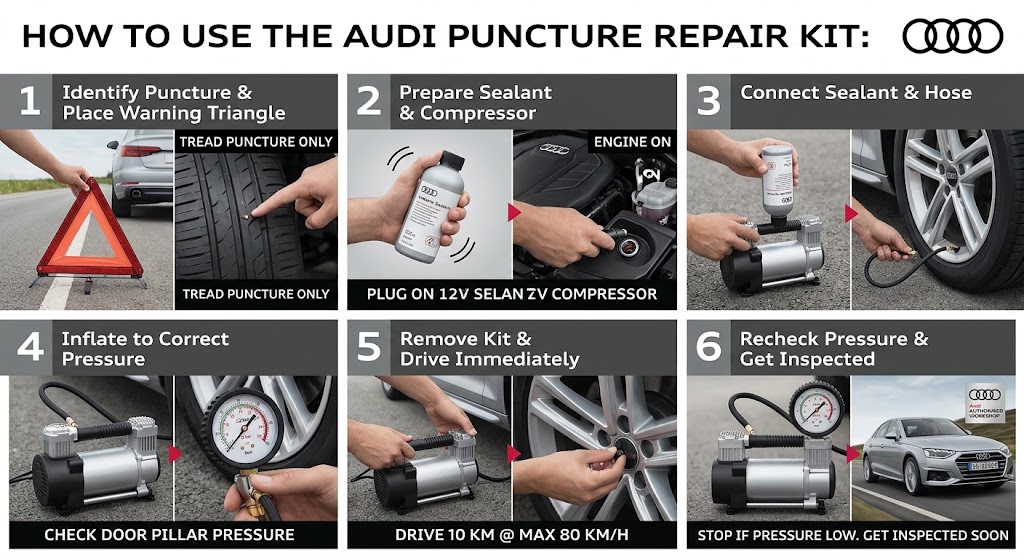
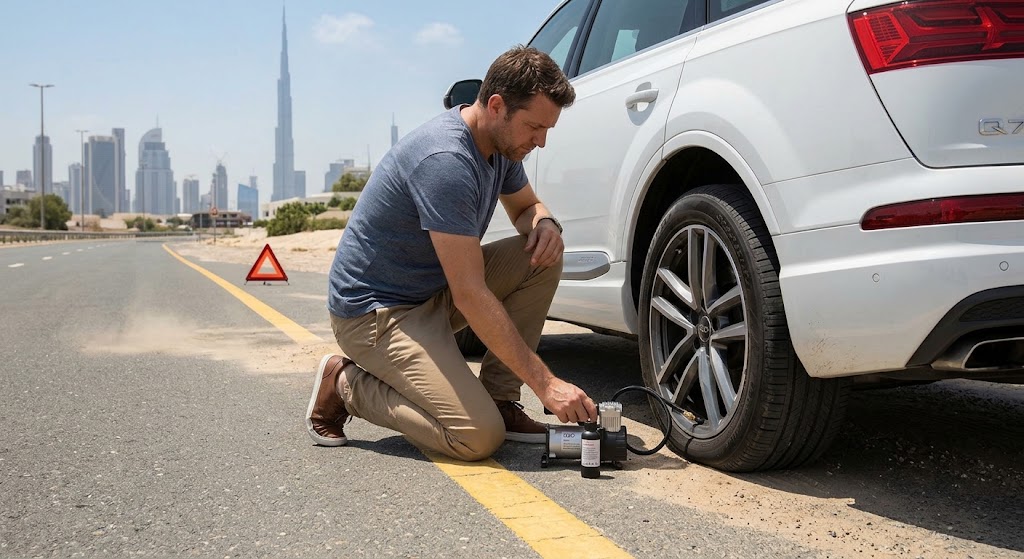
To use the Audi puncture repair kit, stop safely, shake the sealant bottle, connect the hose to the tyre valve, plug the compressor into the 12V socket with the engine running and inflate to the door-pillar pressure. Then drive about 10 km at no more than 80 km/h, recheck the pressure and get the tyre inspected or replaced soon.
A flat tyre on a Dubai road is stressful, especially when you lift the boot floor and find no spare wheel. Many Audis carry a compact tyre mobility kit instead, and once you know how to use the Audi puncture repair kit properly, it can get you off the roadside and safely to a workshop.
This guide covers what the kit can and cannot fix, the exact sequence to follow, the speed and distance limits afterwards, and what needs doing once the emergency is over.
What is in the Audi puncture repair kit and where is it?
The Audi puncture repair kit, which Audi calls a tyre repair set or tyre mobility kit, is a bottle of liquid sealant plus a small 12-volt compressor. Together they seal a minor tread puncture and reinflate the tyre as a temporary fix to get you to a workshop.
What the kit contains
- Sealant bottle: a liquid that is pumped into the tyre, where it coats the inside and plugs small holes as the wheel turns.
- 12V compressor: an electric air pump that plugs into your Audi’s 12-volt power socket.
- Hose: connects the compressor and sealant to the tyre valve.
- Pressure gauge: shows the tyre pressure while you inflate and when you recheck it later.
- Maximum-speed sticker: a reminder label for the driver’s view showing the speed limit after the repair.
Where to find it in your Audi
On most models the kit sits under the luggage compartment floor or in a side compartment of the boot. The exact location varies between models and body styles, so check your owner’s manual now rather than at the roadside.
Why many Audis have no spare wheel
Many modern Audis come with a repair kit instead of a spare wheel to save weight and boot space. Some cars have run-flat or self-sealing tyres instead. The kit is not meant for run-flat tyres, so check the markings on your tyre sidewall and your owner’s manual to see which setup you have.
Check the sealant expiry date
The expiry date is printed on the sealant bottle. Sealant has a limited shelf life, and months in a car boot during a Dubai summer can shorten it. If the date has passed, replace the bottle before you need it, not after.
When can you use the Audi tyre repair kit, and when can’t you?
You can use the kit for one small puncture in the tread, the part of the tyre that touches the road. Anything more serious needs roadside help or a tow, because sealant cannot fix it and driving on it is unsafe.
| Use the kit | Do not use the kit |
|---|---|
| Small puncture in the tread from a nail or screw | Cut, bulge or puncture in the sidewall |
| Object within the size on the kit label (typically about 4–6 mm) | A larger hole or a tear in the tread |
| One tyre losing air | More than one flat tyre |
| Tyre still seated on the rim | Tyre has come off the rim |
| You stopped soon after noticing the tyre going soft | Tyre has been driven flat |
| Standard tyres with in-date sealant | Run-flat tyres, or sealant past its expiry date |
Kit instructions generally tell you to leave a nail or screw in the tyre rather than pulling it out. If you are unsure whether the damage is within the limits on the label, treat it as not repairable with the kit.
Safety first before you start (Dubai roadside and heat)
Your safety matters more than the tyre. Before you touch the kit, get the car and everyone in it away from moving traffic.
- Leave the main road if you can. Stopping on a highway shoulder, such as on Sheikh Zayed Road, is dangerous with traffic passing at high speed. If an exit, service road or car park is close, drive there slowly with the hazard lights on.
- Secure the car. Park on firm, level ground, apply the parking brake and keep the hazard lights on.
- Set up the warning triangle behind the car, far enough back to give approaching drivers time to react.
- Get passengers out on the side away from traffic and have them wait well clear of the road, behind a barrier if there is one.
- Manage the heat. Summer temperatures above 45 °C are common, so drink water, keep passengers in shade where possible and never leave children or pets waiting in a parked car.
- Watch for hot surfaces. Wheels, brakes and asphalt can be very hot after driving, and the compressor itself warms up during use.
How to use the Audi puncture repair kit, step by step
These are the general steps these kits follow. The label on your kit and your owner’s manual always take priority, because details such as how the bottle connects vary between kit designs.
- Stop in a safe place. Hazard lights on, parking brake applied, warning triangle out, and everyone away from traffic.
- Check the damage. Confirm it is a single small puncture in the tread, not the sidewall, and that the tyre is still on the rim. Leave any nail or screw in place.
- Take out the kit and read the label. Check the expiry date on the sealant bottle and note the minimum pressure and maximum speed printed on the kit.
- Fit the speed sticker. Stick the maximum-speed label where you will see it while driving.
- Shake the sealant bottle. Shake it well so the sealant is fully mixed.
- Remove the valve cap. Unscrew the cap from the tyre valve and keep it somewhere safe.
- Connect the hose. Attach the bottle and hose as shown on the kit, then screw the hose firmly onto the tyre valve.
- Start the engine and plug in. With the engine running and the parking brake on, plug the compressor into the 12V socket. Running the engine stops the compressor draining the battery.
- Switch on the compressor. The sealant is pushed into the tyre first, followed by air. Watch the gauge as the pressure rises.
- Inflate to the correct pressure. Use the figure on your tyre-pressure label, usually on the driver’s door pillar or inside the fuel flap. Do not run the compressor for more than about 10 minutes at a time.
- Stop if the minimum pressure is not reached. If the tyre will not reach the minimum shown on the kit label, the damage is too severe. Switch off and call for help.
- Disconnect and drive off straight away. Switch off and unplug the compressor, unscrew the hose, refit the valve cap and stow the kit, then start driving immediately.
Drive, stop and recheck the pressure
As soon as the tyre is inflated, drive about 10 km, or about 10 minutes, at no more than 80 km/h. The wheel needs to turn so the sealant spreads around the inside of the tyre and reaches the hole.
Then stop in a safe place, reconnect the kit and read the pressure on the gauge.
If the pressure is below the minimum
A reading below the minimum on the kit label means the puncture has not sealed. Do not continue driving; call for roadside help or a tow instead.
If the pressure is fine
Top the tyre up with the compressor to the pressure on the tyre-pressure label, disconnect the hose, refit the valve cap and continue carefully.
A note on Dubai heat
Hot asphalt and summer heat raise tyre temperature and pressure, so a tyre that has just been driven reads higher than a cool one. Follow the kit’s recheck procedure now, then check the pressure again once the tyres are cool, such as early the next morning.
How far and how fast can you drive after using tyre sealant?
Keep to a maximum of 80 km/h and get the tyre inspected or replaced as soon as possible. Kit labels commonly limit the distance, often to about 200 km, but the label on your own kit sets the exact figure.
- Speed: 80 km/h at most, as shown on the sticker in your view.
- Distance: treat the repair as a way to reach a workshop, not a fix for the rest of the week.
- Driving style: accelerate gently, avoid harsh braking and sharp cornering, and leave extra stopping distance.
- Route: where possible, choose slower roads over long high-speed highway stretches, and keep to the slower lanes if you must use a highway.
A sealed tyre is not built for normal driving. The longer you leave it, the greater the chance it loses pressure again, and an underinflated tyre on hot summer roads can overheat.
Sealed the tyre and need it checked?
The Audi specialists at Audi Repairs Dubai can inspect the tyre and TPMS sensor with dealer-level quality, source genuine, OEM or quality used parts, and arrange pickup and drop-off across Dubai.
What to do after the emergency repair
Once you are off the road, three jobs remain: have the tyre inspected or replaced, have the pressure sensor checked, and replace the sealant bottle.
Get the tyre inspected or replaced
A technician needs to take the tyre off the wheel to see the real extent of the damage. Tell them sealant was used before they start, so they can clean it out. Whether the tyre can be properly repaired depends on the damage and its condition, and in many cases replacement is the safer choice.
Have the TPMS sensor checked
On cars with a tyre-pressure monitoring system (TPMS) sensor fitted inside the wheel, sealant can coat the sensor. It may need cleaning or replacing. If the tyre-pressure warning stays on after the tyre is sorted, ask for the sensor to be checked.
Replace the sealant bottle
The sealant bottle must be replaced before the kit can be used again. While you are at it, make sure the compressor, hose and gauge are back in their place in the boot.
Common mistakes to avoid with the Audi tyre sealant and compressor
Most failed roadside repairs come down to a handful of avoidable errors.
- Using the kit on the wrong damage, such as a sidewall cut or a tyre that has been driven flat.
- Relying on expired sealant that has sat in a hot boot for years.
- Running the compressor with the engine off, which can drain the battery.
- Running the compressor too long, beyond about 10 minutes at a time, when the tyre clearly is not holding air.
- Waiting before driving off, instead of moving immediately so the sealant spreads.
- Skipping the recheck after the first 10 km or so.
- Driving faster than 80 km/h or using the sealed tyre for days.
- Not telling the technician that sealant is inside the tyre.
- Forgetting to replace the bottle, leaving you with an empty kit next time.
Frequently asked questions about how to use Audi puncture repair kit
Can I drive on the highway after using the Audi tyre sealant?
You can use a highway if you have to, but keep to 80 km/h or less and stay in the slower lanes. Driving faster on a sealed tyre is not safe, which is why the kit sets a maximum speed. Where possible, choose slower roads and get the tyre inspected as soon as you can.
How long does Audi tyre sealant last in the bottle?
Sealant has a limited shelf life, and the expiry date is printed on the bottle. Heat shortens it, which matters when the kit spends Dubai summers in a hot boot. Check the date whenever your car is serviced and replace the bottle once it has expired.
Does tyre sealant damage the TPMS sensor?
It can. Sealant may coat a tyre-pressure sensor fitted inside the wheel, so the sensor may need cleaning or replacing after the repair. Tell the technician that sealant was used so they can check the sensor while the tyre is off the wheel.
Can a tyre be repaired after using sealant?
Sometimes, but it depends on the size and position of the damage and the condition of the tyre. The technician must remove the tyre, clean out the sealant and inspect it from the inside before deciding. In many cases replacement is the safer option, and Audi Repairs Dubai can inspect the tyre and advise you.
Why does my Audi not have a spare wheel?
Many modern Audis come with a puncture repair kit instead of a spare wheel to save weight and boot space. Some models use run-flat or self-sealing tyres instead. Check your owner’s manual and the tyre sidewall to see which setup your car has.
Can I use the kit on a sidewall puncture?
No. The kit is only for small punctures in the tread, and sidewall damage cannot be sealed safely. If the sidewall is cut, bulged or punctured, do not drive on it; call for roadside help or a tow.
What if the compressor will not reach the right pressure?
If the tyre does not reach the minimum pressure shown on the kit label, the damage is too large for sealant. Switch off the compressor, do not drive on the tyre and call for help. Do not keep running the compressor beyond about 10 minutes at a time trying to force it.
Where do I buy a replacement sealant bottle?
Replace the bottle after every use or once it passes its expiry date, and make sure it matches the kit fitted in your car. Audi Repairs Dubai can source a genuine or OEM replacement bottle for your Audi; send your model on WhatsApp to +971 52 791 4606.
Need help with your Audi in Dubai?
Audi Repairs Dubai is an independent Audi specialist offering dealer-level quality as a dealer alternative. Our Audi specialists can check your tyre and TPMS sensor after a sealant repair and source genuine, OEM or quality used parts, with pickup and drop-off across Dubai. Message us on WhatsApp or visit audirepairsdubai.ae.